
Courts in Hartford
Navigating courts in Hartford connects residents directly to state appellate, judicial district, and specialized municipal courtrooms across Connecticut's capital. Understanding the jurisdictional division between the Hartford Judicial District Courthouse and Geographical Area 14 ensures accurate case filing and procedural compliance. Explore our comprehensive directory below to locate verified courthouse addresses, operational dockets, and official clerk procedures across Hartford.


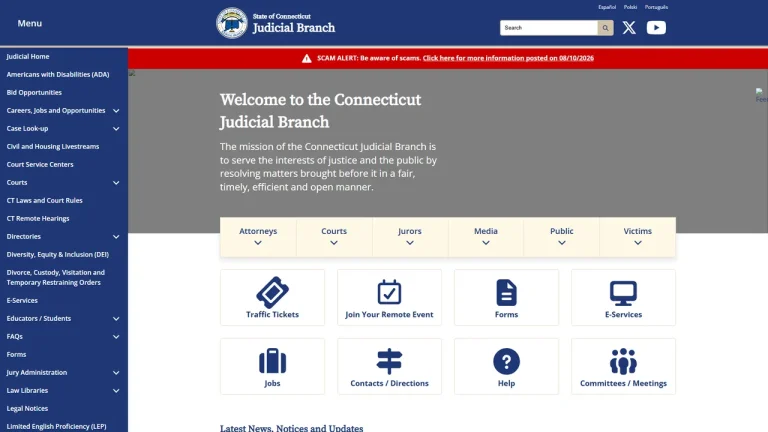

Judicial Administration and Court Hierarchy in Hartford, Connecticut
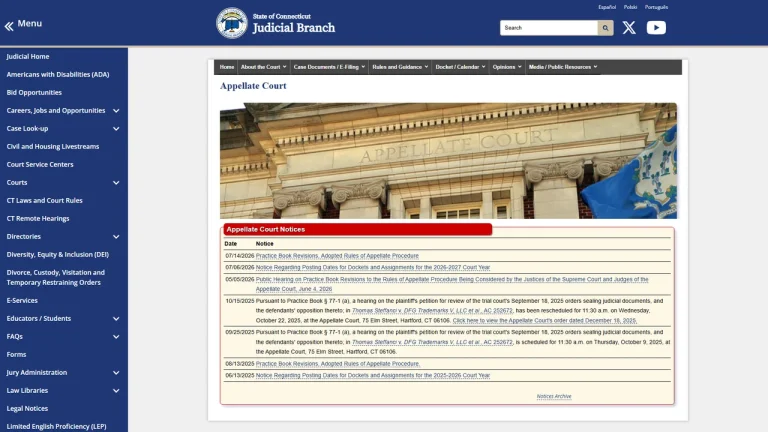
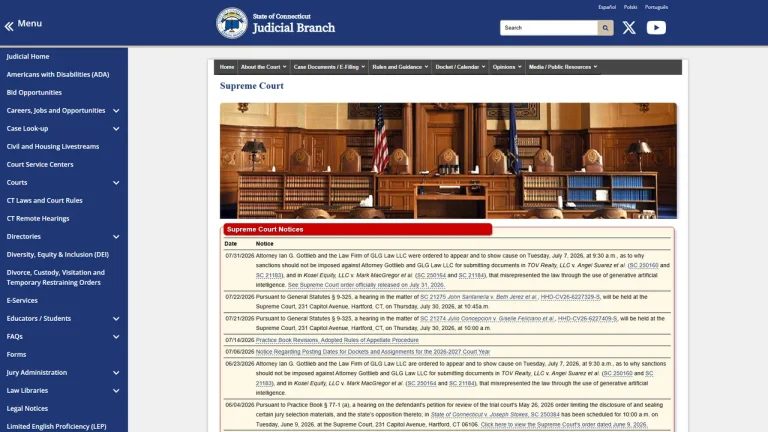
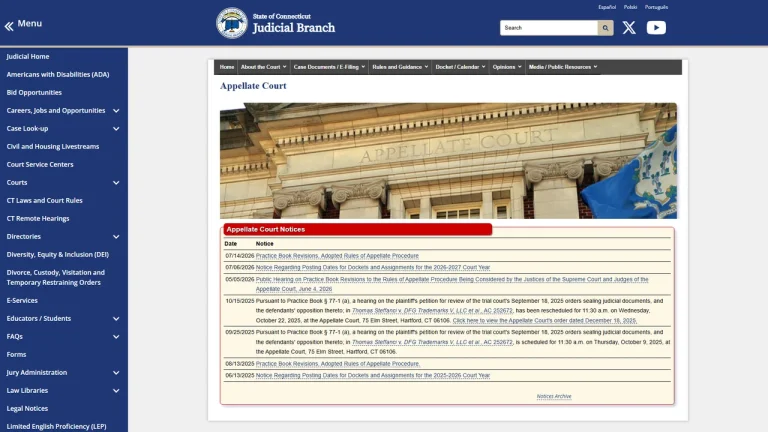
Hartford serves as the judicial and administrative epicenter of Connecticut, hosting both the state's highest appellate tribunals and the primary trial courts for the Hartford Judicial District. The Connecticut Supreme Court sits at 231 Capitol Avenue, exercising discretionary and mandatory appellate jurisdiction, while the Connecticut Appellate Court conducts intermediate appeals at 75 Elm Street.
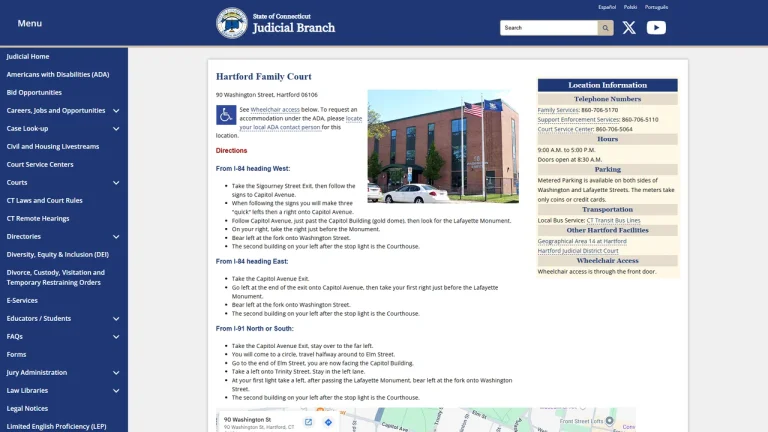
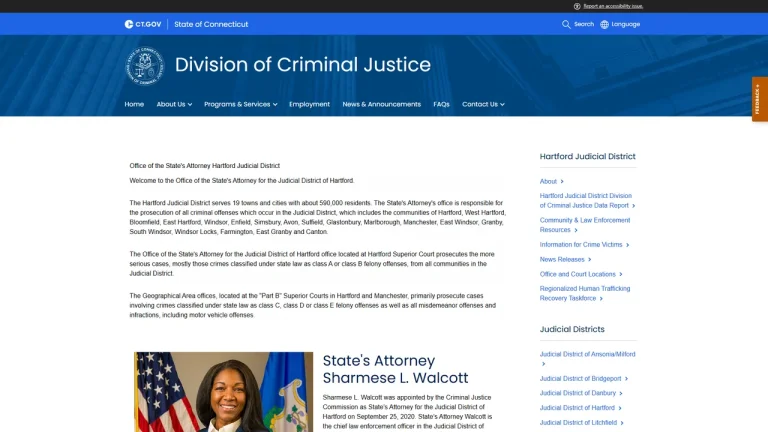
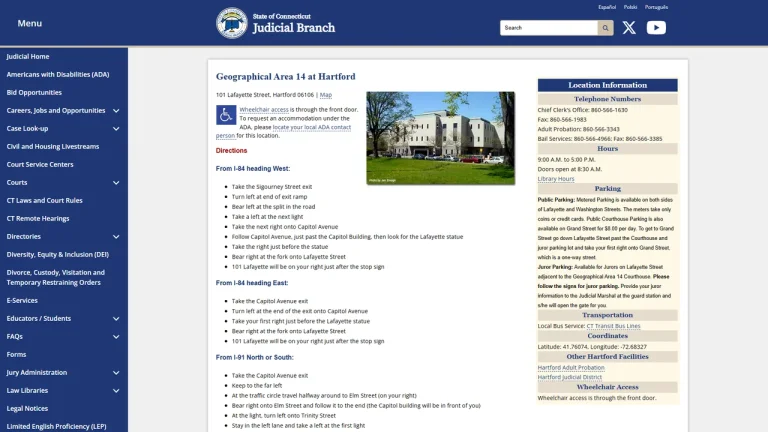
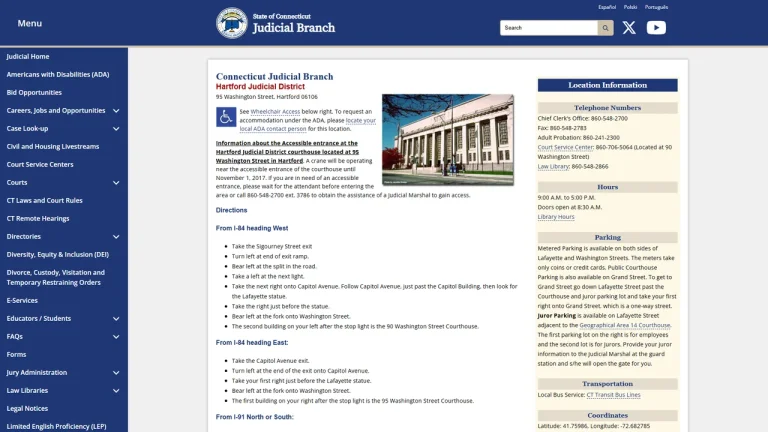
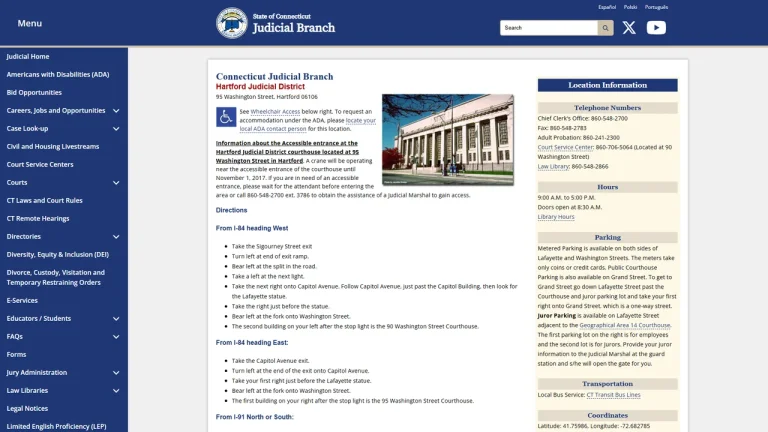
General trial jurisdiction for Hartford County is centered around Washington and Lafayette Streets. Major civil disputes exceeding statutory thresholds, family law dissolutions, and felony Part A criminal indictments are adjudicated at the Hartford Judicial District Courthouse at 95 Washington Street. Misdemeanor criminal offenses, motor vehicle infractions, and preliminary criminal arraignments are conducted at Geographical Area No. 14 (G.A. 14) Courthouse at 101 Lafayette Street, serving Hartford and surrounding suburbs including Bloomfield, East Hartford, Glastonbury, and West Hartford.
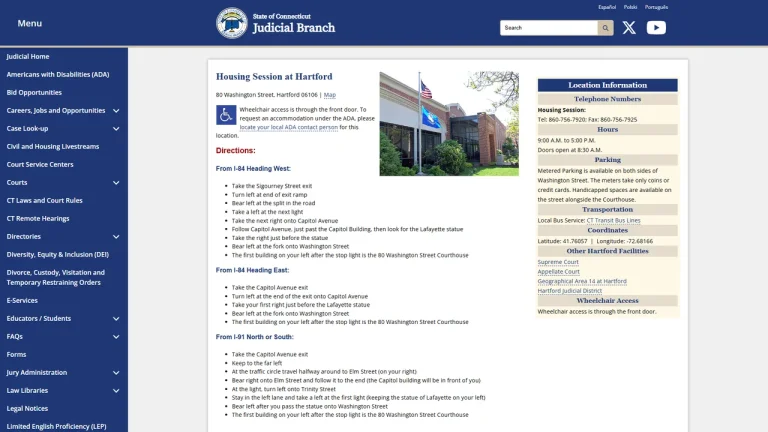
Hartford also operates specialized court venues, including the Hartford Community Court and the Housing Session at 80 Washington Street, addressing quality-of-life offenses and summary process eviction matters. Juvenile delinquency and child protection proceedings are heard at the Hartford Superior Court for Juvenile Matters at 920 Broad Street. Estate administration and conservatorships are directed through the Hartford Probate Court at 250 Constitution Plaza. All civil and criminal dockets are coordinated through the Connecticut Judicial Branch E-Services digital infrastructure.
Core Court Services, Document Prerequisites, and Timelines in Hartford
| Service / Matter | Required Documents / Prerequisites | Statutory Fee (USD) | Processing Timeline |
|---|---|---|---|
| Superior Court Small Claims Action | Small claims writ and notice of suit, defendant Hartford County address, itemized evidence of debt | $95.00 statutory entry fee | Answer due within 30 days of docketing |
| Civil Action Entry (Hartford Judicial District) | Formal summons, verified complaint, state marshal return of service | $360.00 base civil filing fee | Return date set 2 to 6 weeks following service |
| Housing Session Summary Process (Eviction) | Notice to quit, verified summary process summons and complaint, marshal return | $175.00 entry fee | Appearance required within 2 days after return date |
| Certified Court Records / Transcript Retrieval | Case docket number, formal request form submitted to Superior Court Clerk | $25.00 search fee plus $1.00 per page copy fee | 3 to 5 business days for certified document issuance |
Critical Legal Deadlines & Statutes in Connecticut
Engaging with state and local courts in Hartford requires strict adherence to statutory deadlines codified under Connecticut law. Claimants asserting tort liability against the City of Hartford for injuries caused by defective highways or sidewalks must serve written notice of claim upon the Town and City Clerk within 90 days of the incident pursuant to Conn. Gen. Stat. § 13a-149 before initiating any civil lawsuit.
General civil actions follow statewide limitation periods. Personal injury actions and property damage lawsuits must be commenced within 2 years from the date of the injury pursuant to Conn. Gen. Stat. § 52-584. Breach of written contract actions carry a 6-year statute of limitations under Conn. Gen. Stat. § 52-576. In eviction proceedings, tenants must enter an appearance within 2 days following the return day pursuant to Conn. Gen. Stat. § 47a-26. In criminal matters, speedy trial protections for incarcerated defendants are enforced under Conn. Gen. Stat. § 54-82m, and appeals from public record denials must be filed with the Freedom of Information Commission within 30 days under Conn. Gen. Stat. § 1-206.
Direct Court Navigation vs. Retaining Legal Counsel
Individuals in Hartford can independently manage routine court matters using established administrative channels. Self-represented litigants can file Small Claims actions for monetary claims up to $5,000 pursuant to Conn. Gen. Stat. § 51-15, submit appearances via the Connecticut Judicial Branch E-Services portal, access public case dockets, and request emergency civil restraining orders under Conn. Gen. Stat. § 46b-15 without an attorney. Uncontested estate administrations at the Hartford Probate Court can also be completed through standardized pro se forms.
Conversely, complex civil litigation and serious criminal defense require skilled legal representation. Defending against Part A felony charges at 95 Washington Street, litigating contested divorces involving equitable property division under Conn. Gen. Stat. § 46b-81, or managing commercial lawsuits involves complex procedural requirements under the Connecticut Practice Book and Connecticut Code of Evidence. Retaining an attorney licensed by the Connecticut Judicial Branch ensures statutory rights are protected and filing deadlines are met before trial judges.
Red Flags & Public Service Scams to Avoid
- Unofficial Court Filing Websites: Be wary of commercial websites that charge high service fees to file court documents or view dockets that can be accessed directly for free or standard statutory fees through Connecticut Judicial Branch E-Services.
- Unlicensed Legal Advisors: Non-lawyers, notaries public, and paralegals cannot provide legal advice, draft court pleadings, or represent parties in Connecticut courtrooms without a valid law license.
- Court Officer Impersonation Schemes: State marshals and court clerks in Hartford never call residents demanding immediate payments via wire transfers, prepaid debit cards, or cryptocurrency to dismiss arrest warrants or missed jury duty sanctions.
- Deceptive Eviction Assistance Companies: Beware of unaccredited commercial entities offering guaranteed eviction delays or defenses for cash, which frequently file improper pleadings resulting in default judgments.
Frequently Asked Questions
Where are misdemeanor criminal cases and traffic tickets heard in Hartford?
Misdemeanor criminal arraignments, motor vehicle infractions, and town ordinance violations in Hartford are heard at the Geographical Area No. 14 (G.A. 14) Courthouse, located at 101 Lafayette Street in Hartford.
Where do I file a major civil lawsuit or divorce petition in Hartford?
Major civil lawsuits, family law dissolutions, and felony Part A criminal cases are filed and heard at the Hartford Judicial District Courthouse, located at 95 Washington Street in Hartford.
What is the monetary limit for Small Claims cases in Hartford?
The statutory limit for Small Claims cases in Connecticut Superior Court is $5,000. These cases handle claims for money damages, contract breaches, and property reimbursement under simplified court procedures.
Which courthouse handles landlord-tenant eviction cases in Hartford?
Summary process eviction matters in Hartford are adjudicated at the Housing Session of the Hartford Judicial District, located at 80 Washington Street in Hartford.
Where is the Hartford Probate Court located?
The Hartford Probate Court is located at 250 Constitution Plaza, 3rd Floor, in downtown Hartford. It oversees estate administration, probate of wills, conservatorships, and guardianships.