
Law Enforcement & Corrections in Connecticut
Connecticut law enforcement agencies and unified state correctional facilities operate under strict statutory custody and procedural accountability standards. Navigating inmate visitation, bail procedures, and records access requires following specific Department of Correction rules. Access our statewide directory below to find certified police departments, state trooper barracks, and correctional centers.

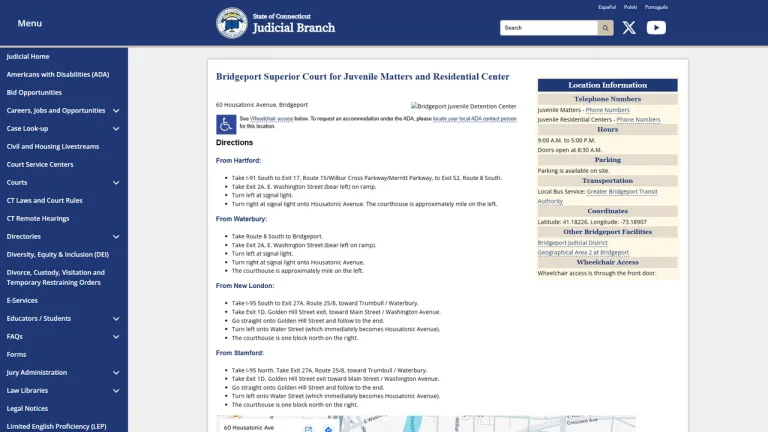

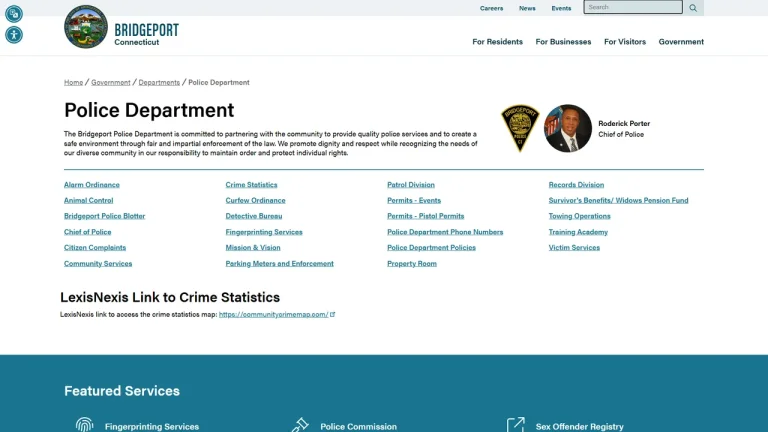



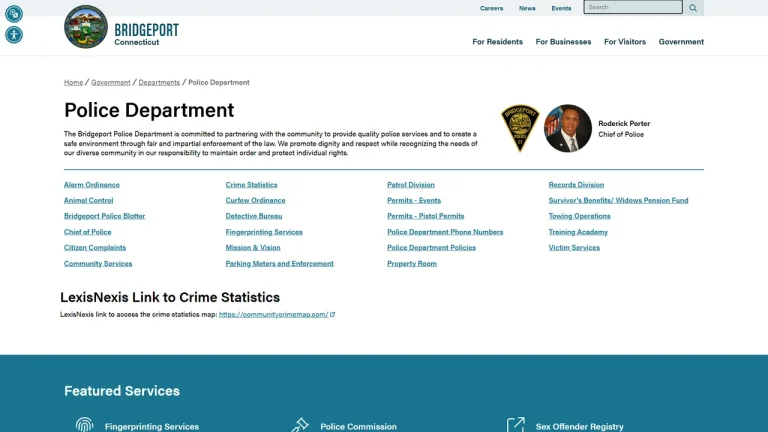
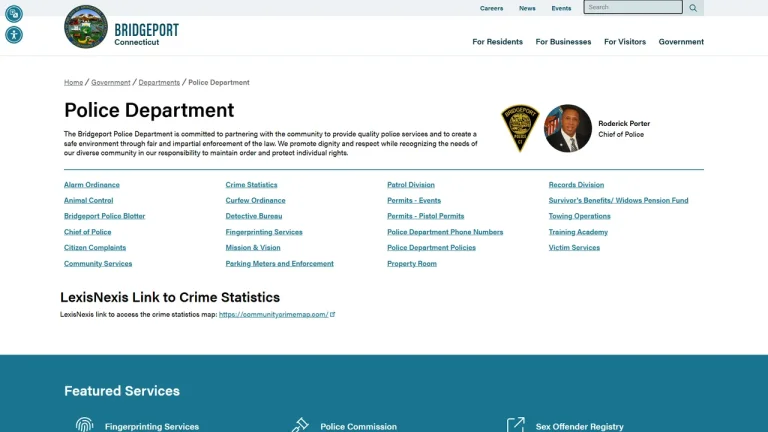
Bridgeport Police Department - Pistol Permits - Bridgeport, CT


Connecticut Law Enforcement Structure and Unified Correctional Jurisdiction
Law enforcement and correctional administration in Connecticut operate through a centralized state framework coupled with municipal police departments. Unlike states with county sheriffs and county-run jails, Connecticut maintains a unified structure. Municipal police departments deliver front-line policing in cities and towns such as Bridgeport, New Haven, Hartford, Waterbury, and Stamford, while the Connecticut State Police-a division of the Department of Emergency Services and Public Protection (DESPP)-provides highway patrol and resident state trooper coverage across 11 regional barracks (Troops A through L).
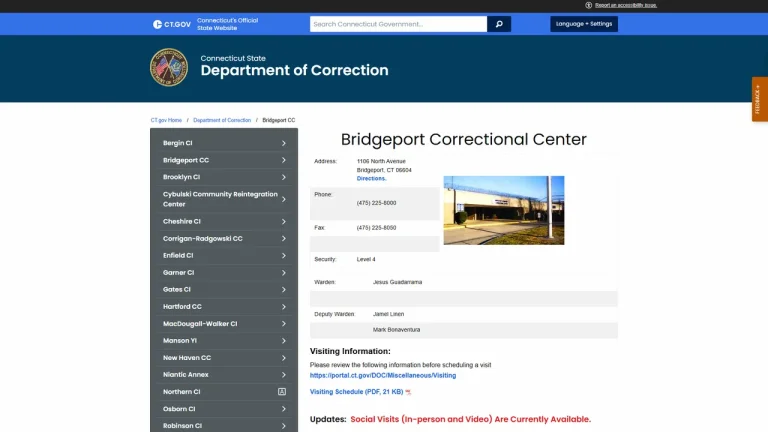
Corrections across Connecticut are uniquely integrated under the sole authority of the Connecticut Department of Correction (DOC), headquartered in Wethersfield. Connecticut does not operate county jails. Instead, the CT DOC manages both pre-trial detention centers-such as the Hartford Correctional Center, Bridgeport Correctional Center, and New Haven Correctional Center-and sentenced institutions across the state. This unified model ensures that all intake, custodial supervision, medical care, and inmate records are maintained within a single statewide correctional infrastructure.
Court security and judicial custody are administered by the Connecticut Judicial Branch Judicial Marshals, who oversee prisoner transit and courthouse lockup facilities. Criminal cases originate in the Connecticut Superior Court system, divided into Geographical Area (GA) Courts for arraignments and misdemeanors, and Judicial District (JD) Courts for major felony trials. Understanding agency authority is crucial when seeking police records, posting bail, or locating an individual in custody.
Law Enforcement Services, Inmate Processing, and Fee Schedules
| Service / Matter | Required Documents / Prerequisites | Statutory Fee (USD) | Processing Timeline |
|---|---|---|---|
| State Criminal History Record Search (DESPP) | Fingerprint card (DESPP-49-C), signed consent, valid government photo ID | $75 state fee + $15 fingerprint fee | 4 to 8 weeks by mail; expedited online |
| Pre-Trial Inmate Bail Bond Posting | Valid state photo ID, cash bail amount or licensed surety bondsman verification | $0 court fee; capped bondsman premium | 2 to 6 hours following booking |
| Municipal Police Accident / Incident Report | Case file number, date and location of occurrence, formal request form | $0.50 per page or $5 to $16 flat fee | 3 to 7 business days |
| Correctional Facility Inmate Visitation Registration | Completed visitor application form, background clearance, valid identification | $0 (Statutory public service) | 2 to 4 weeks for approval |
Critical Legal Deadlines & Statutes in Connecticut
Criminal procedure, custodial rights, and bail practices in Connecticut are governed by stringent statutory timelines. When an individual is arrested and detained without posting bond, state law requires prompt judicial presentation. Under Conn. Gen. Stat. § 54-1g, an arrested person who remains in custody must be presented at the very next session of the Superior Court for the Geographical Area in which the offense is alleged to have occurred.
Statutory limitations on criminal prosecutions are codified in Conn. Gen. Stat. § 54-193. While class A felonies (such as murder) have no statute of limitations, prosecutions for most other felonies must commence within five years, and misdemeanor offenses carry a one-year statute of limitations. In addition, surety bail fees are strictly regulated under Conn. Gen. Stat. § 38a-660, which establishes that licensed bail bondsmen may not charge premium rates exceeding 10% on bonds up to $5,000 and 7% on amounts above $5,000.
Navigating Law Enforcement Procedures: Self-Representation vs. Criminal Defense Counsel
Certain interactions with law enforcement and the Department of Correction are administrative in nature and do not require legal representation. Members of the public can independently request certified traffic accident reports from a local police records division, deposit funds into an inmate's commissary trust account, or submit visitor applications directly through the Department of Correction website. The civil Small Claims Session governed by Conn. Gen. Stat. § 51-15 handles property disputes up to $5,000, but has no authority over criminal or penal matters.
When an individual faces custodial interrogation, formal booking, or an arraignment hearing before a Superior Court judge, retaining experienced criminal defense counsel admitted to the Connecticut Bar is imperative. Attempting self-representation during criminal investigations risks the inadvertent forfeiture of constitutional protections against self-incrimination. A qualified attorney can petition for bail modification, negotiate with the State's Attorney, challenge unlawful searches under state law, or secure appointed representation through the Public Defender Services Commission pursuant to Conn. Gen. Stat. § 51-296.
Red Flags & Consumer Warnings for Corrections and Bail
- Unlicensed bail agents demanding non-refundable fees that exceed the mandatory statutory rate caps outlined in Conn. Gen. Stat. § 38a-660.
- Impersonation scams involving telephone calls from individuals claiming to be Connecticut State Troopers or Judicial Marshals demanding immediate digital payments to clear arrest warrants.
- Third-party commercial websites charging recurring subscription fees to locate Connecticut inmates when the Department of Correction provides free online inmate lookups.
- Unauthorized legal intermediaries soliciting families outside pre-trial detention facilities like the Hartford or Bridgeport Correctional Centers promising guaranteed case dismissals.
Frequently Asked Questions
Does Connecticut have county sheriffs or county jails?
No. Connecticut abolished the county sheriff system in 2000 and abolished county government in 1960. All jails, detention facilities, and prisons are unified under the state-level Connecticut Department of Correction, and courthouse custody is managed by Judicial Marshals.
How can I locate an inmate incarcerated in Connecticut?
You can verify an inmate's facility location and custodial status through the Connecticut Department of Correction online Inmate Information Search using the inmate's legal name or DOC identification number.
What is the statutory limit on bail bond fees in Connecticut?
Under Conn. Gen. Stat. § 38a-660, licensed professional surety bondsmen may legally charge up to 10% on the first $5,000 of a bond and up to 7% on any amount exceeding $5,000.
How quickly must a detainee be arraigned in Connecticut?
Pursuant to Conn. Gen. Stat. § 54-1g, an individual arrested and held in custody must be presented before the judge at the next available session of the Superior Court Geographical Area (GA) court.
Where can I obtain a copy of a Connecticut State Police crash report?
Crash reports for highway incidents investigated by the Connecticut State Police must be requested through the DESPP Division of State Police Reports and Records Section or via their certified electronic reporting system.