
Federal Law Enforcement in Illinois
Federal law enforcement agencies in Illinois investigate interstate crime, federal offenses, and national security matters across three judicial districts. Navigating federal grand jury subpoenas and statutory detention hearings requires immediate strategic legal action. Explore our directory below to locate FBI field offices, U.S. Marshals divisions, federal detention centers, and federal investigative bureaus across Illinois.
U.S. Attorney's Office - Northern District of Illinois - Chicago, IL

United States Attorney's Office, Northern District of Illinois - Chicago, IL


Bureau of Alcohol, Tobacco, Firearms and Explosives - Chicago, IL


Federal Law Enforcement Architecture and Judicial Districts in Illinois
Federal law enforcement operations across Illinois are structured across three federal judicial districts: the Northern District of Illinois, the Central District of Illinois, and the Southern District of Illinois. Primary prosecutorial and investigative priorities are established by the respective United States Attorney's Offices in coordination with major federal investigative bureaus. The Northern District, with major courthouses including the Everett McKinley Dirksen United States Courthouse in downtown Chicago and the Stanley J. Roszkowski United States Courthouse in Rockford, handles high volumes of complex financial crime, national security, public corruption, and international narcotics investigations.
Major federal investigative agencies maintain significant operations in Illinois. The Federal Bureau of Investigation (FBI) operates its Chicago Field Office on West Roosevelt Road-one of the largest field divisions in the country-alongside the FBI Springfield Field Office, which oversees operations across central and southern counties. The Drug Enforcement Administration (DEA) directs operations through its Chicago Division, targeting major illicit distribution corridors along interstate networks. The Bureau of Alcohol, Tobacco, Firearms and Explosives (ATF) maintains an active presence targeting violent firearms trafficking, while Homeland Security Investigations (HSI) and the United States Postal Inspection Service (USPIS) manage trade fraud, customs enforcement, and mail fraud.
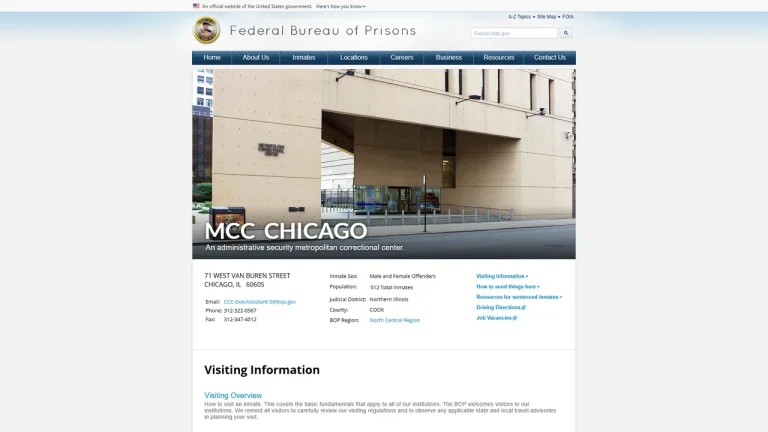
Detention, judicial protection, and post-indictment custody fall under the United States Marshals Service (USMS) and the Federal Bureau of Prisons (BOP). In Chicago, pretrial detainees in federal custody are held at the Metropolitan Correctional Center (MCC Chicago), a high-rise detention facility situated on South Dearborn Street. In downstate Illinois, federal prison operations include the United States Penitentiary (USP) Marion in Williamson County, the Federal Correctional Institution (FCI) Greenville in Bond County, and the Thomson federal facility (AUSP Thomson) in Carroll County.
Key Federal Investigative Proceedings, Fees, and Timelines
| Service / Matter | Required Documents / Prerequisites | Statutory Fee (USD) | Processing Timeline |
|---|---|---|---|
| Federal Grand Jury Subpoena Response | Subpoena Duces Tecum, Responsive Corporate or Personal Records | $0 (mandatory compliance) | 10 to 20 days as designated in subpoena |
| Federal Bail Reform Act Detention Hearing | Pretrial Services Report, Financial Disclosures, Proposed Third-Party Custodian | $0 (hearing proceeding) | Conducted within 3 to 5 days of initial appearance |
| Federal FOIA Records Request | Formal FOIA Submission, Proof of Identity, Specific System of Records | $0 base (search fees may apply) | 20 business days statutory timeline |
| MCC Chicago Inmate Visitation Approval | Form BP-A0629, Inmate Consent, Government Photo ID, Background Check | $0 | 30 to 45 business days for BOP review |
Critical Legal Deadlines & Statutes in Illinois
Federal criminal investigations and prosecutions in Illinois operate under rigorous procedural timelines established by the Federal Rules of Criminal Procedure and federal statutory codes. When a person is arrested on a federal criminal complaint or indictment, Fed. R. Crim. P. 5 mandates that they must be brought before a United States Magistrate Judge without unnecessary delay for an initial appearance. If the Assistant United States Attorney files a motion for pretrial detention under the Bail Reform Act at 18 U.S. Code § 3142, the detention hearing must be held immediately, or within three days if requested by the government, or five days if requested by the defense.
Subsequent prosecutorial actions are strictly governed by the federal Speedy Trial Act. Under 18 U.S. Code § 3161, an indictment or criminal information must be filed within 30 calendar days from the date of an individual's arrest. Following the entry of a not-guilty plea, trial must commence within 70 calendar days, excluding excludable time periods granted for pretrial motions under Fed. R. Crim. P. 12. In investigative stages, grand jury proceedings are held in strict secrecy under Fed. R. Crim. P. 6(e), and witnesses or targets served with subpoenas must file motions to quash before the return date specified on the subpoena face. Additionally, federal public records inquiries directed to the FBI, DEA, or ATF must be answered within 20 business days pursuant to the federal Freedom of Information Act at 5 U.S. Code § 552.
Direct Agency Interaction vs. Retaining Federal Criminal Defense Counsel
Direct citizen interactions with federal law enforcement are generally limited to specific administrative procedures. Individuals may submit confidential criminal tips through FBI or ATF online portals, file administrative FOIA requests to obtain non-exempt agency records, or complete visitor registration paperwork for family members held at MCC Chicago or FCI Greenville without legal counsel.
However, whenever an individual or corporate entity becomes the subject of a federal inquiry, retaining a qualified federal criminal defense attorney admitted to practice in the Northern, Central, or Southern District of Illinois is paramount. Making voluntary statements to federal agents without counsel carries severe criminal exposure under 18 U.S. Code § 1001, which criminalizes false statements to federal officers. An attorney is essential for responding to federal grand jury subpoenas, negotiating immunity agreements, defending against pre-trial detention motions under the statutory presumptions of 18 U.S. Code § 3142(e), conducting discovery under the Jencks Act, and negotiating plea agreements under Fed. R. Crim. P. 11.
Red Flags & Federal Enforcement Alerts in Illinois
- Telephone imposters claiming to be Special Agents with the FBI, DEA, or U.S. Marshals threatening imminent arrest or passport revocation unless funds are wired or paid via gift cards.
- Individuals attempting to answer questions or submit documents to federal investigators during an unannounced workplace or home visit without an attorney present.
- Third-party consultants promising guaranteed compassionate release or sentence reduction from federal facilities like MCC Chicago without formal court motions under 18 U.S. Code § 3582.
- Attorneys who lack formal admission to the federal trial bar in the U.S. District Court for the Northern, Central, or Southern District of Illinois attempting to handle federal indictments.
Frequently Asked Questions
What federal judicial districts exist in Illinois?
Illinois is divided into three federal judicial districts: the Northern District of Illinois (Chicago and Rockford), the Central District of Illinois (Springfield, Peoria, Urbana, and Rock Island), and the Southern District of Illinois (East St. Louis and Benton).
Where is the FBI field office located in Chicago?
The FBI Chicago Field Office is located at 2111 West Roosevelt Road in Chicago, directing federal criminal and counterterrorism investigations across northern Illinois.
What should I do if federal agents serve a search warrant at my business or home?
Request to examine the signed search warrant, verify the physical premises and property authorized for seizure, refrain from answering investigative questions without counsel, and immediately contact a licensed federal criminal defense attorney.
Where are federal pretrial detainees incarcerated in Chicago?
Federal defendants detained prior to trial in the Northern District of Illinois are predominantly held at the Metropolitan Correctional Center (MCC Chicago), an urban detention facility operated by the Federal Bureau of Prisons in downtown Chicago.
What is a federal target letter from the U.S. Attorney's Office?
A target letter is a formal notification from a United States Attorney informing an individual that a federal grand jury has gathered substantial evidence linking them to a federal crime and that indictment is being sought, requiring immediate engagement of defense counsel.