
Jails, Prisons & Detention Centers in Maine
Locating an incarcerated individual in Maine requires navigating either county detention facilities or state-operated correctional facilities. Public booking registries and official inmate search tools provide real-time custody status, bail terms, and visitation protocols across all sixteen counties. Explore our verified directory below to identify facility contacts, bail procedures, and official visitation guidelines.


Correctional Facility Jurisdictions and Inmate Custody in Maine
Maine operates a dual-level correctional framework divided strictly between county government detention centers and statewide correctional facilities managed by the Maine Department of Corrections (MDOC). County sheriff offices oversee local detention facilities across Maine's sixteen counties, housing individuals awaiting trial, detainees held on pre-trial bail conditions, and individuals serving misdemeanor sentences typically not exceeding nine months. Facilities such as the Cumberland County Jail in Portland, the York County Jail in Alfred, and the Penobscot County Jail in Bangor serve as regional intake hubs for local law enforcement agencies.
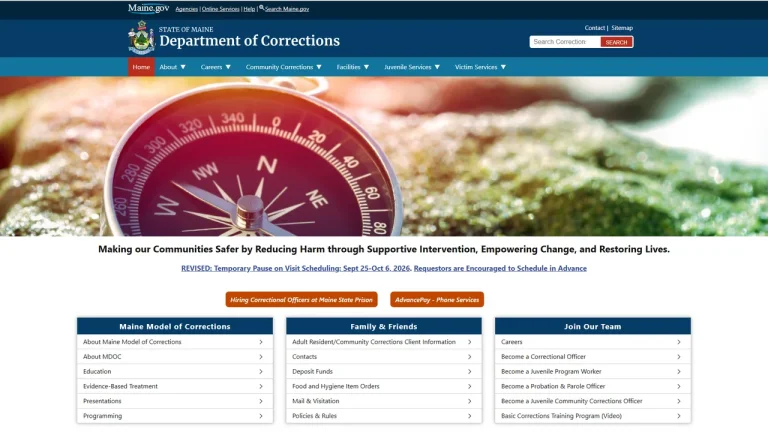
Individuals convicted of felony offenses or sentenced to terms exceeding nine months fall under the executive jurisdiction of the Maine Department of Corrections, headquartered in Augusta. Major state institutions include the Maine State Prison in Warren, the Maine Correctional Center in Windham, and the Mountain View Correctional Facility in Charleston. Each level of incarceration maintains separate administrative rules regarding inmate communication, attorney access, and commissary management.
Understanding whether an individual is in county pre-trial custody or state post-conviction custody is essential for securing prompt release, coordinating legal representation, or exercising formal visitation rights. Inmate locations, bail amounts set by judicial officers or local bail commissioners, and booking numbers can be verified through county jail rosters or the central MDOC Adult Prisoner Inmate Search database.
Inmate Processing, Bail, and Public Records Schedule
| Service / Matter | Required Documents / Prerequisites | Statutory Fee (USD) | Processing Timeline |
|---|---|---|---|
| Cash Bail Release via Bail Commissioner | Valid government-issued photo ID, cash or certified funds, signed release order | $60 Bail Commissioner fee plus court-ordered bail amount | 2 to 6 hours after booking completion |
| Inmate Telephone and Video Visitation Registration | Valid state driver's license or state ID, approval on inmate visitor list | Variable carrier rates ($0.12-$0.20 per minute) | 3 to 7 business days for visitor clearance |
| County Jail Booking Blotter and Incident Public Record | Formal written request citing the Maine Freedom of Access Act (FOAA) | $0.10-$0.25 per page; no search fee for first 2 hours | 5 working days to acknowledge; 10 to 20 days for fulfillment |
| Inmate Commissary Fund Transfer | Inmate full legal name, MDOC or county booking number, authorized payment method | $2.50-$6.95 merchant processing transaction fee | Real-time to 24 hours depending on deposit system |
Critical Legal Deadlines & Statutes in Maine
Detention, bail review, and public records administration in Maine are strictly governed by statutory timelines designed to safeguard constitutional guarantees and procedural transparency. Under Me. Rev. Stat. tit. 15 § 1026, every person arrested without a warrant has the statutory right to an individualized bail determination that imposes the least restrictive conditions necessary to ensure court appearance and public safety.
When an arrestee cannot post bail, the Maine Rules of Unified Criminal Procedure require that an initial court appearance and formal bail review take place within 48 hours of detention, excluding weekends and recognized court holidays. County jail administration and sheriff duties are formally structured under Me. Rev. Stat. tit. 30-A § 1501, which mandates the humane treatment of prisoners and the maintaining of accurate public calendars of all committed individuals.
For state-administered correctional institutions, operational standards, inmate grievances, and disciplinary actions operate under Me. Rev. Stat. tit. 34-A § 3001. When members of the public or legal representatives submit formal requests for custody documentation, detention logs, or jail policy directives, government custodians must comply with the Maine Freedom of Access Act under Me. Rev. Stat. tit. 1 § 408-A, which requires an official agency response or acknowledgment within 5 working days of receiving the request.
Direct Facility Navigation vs. Criminal Defense Representation
Families and members of the public can independently complete several administrative processes directly through facility portals without hiring legal counsel. Direct self-service tasks include depositing funds into an inmate trust account, registering for approved remote video visitation through third-party contracting platforms, and confirming an inmate's scheduled court date on the Maine Judicial Branch docket. Similarly, standard requests for non-confidential public arrest logs may be filed directly with the records division of the relevant county sheriff.
Conversely, retaining a qualified criminal defense attorney becomes necessary whenever liberty interests, constitutional protections, and complex evidentiary procedures are at stake. A licensed defense attorney is essential for arguing for bail reductions before a District Court or Superior Court judge, representing detainees during unexpected probation revocation proceedings, and challenging unconstitutional conditions of confinement or denial of medical treatment under federal civil rights protections. Attorneys also ensure privileged communication during inmate interviews, preventing confidential legal strategy from exposure through monitored jail phone lines.
Red Flags, Scams, and Inmate Service Safeguards
- Beware of unauthorized third-party websites that charge recurring monthly subscriptions to search public Maine inmate records, which are freely accessible through official county sheriff portals and the Maine DOC database.
- Never wire money, purchase prepaid retail debit cards, or send cryptocurrency to individuals claiming an inmate will be immediately released upon payment, as official bail must be paid directly to a licensed bail commissioner or the court clerk.
- Reject solicitations from unverified private transport services or unaccredited bail expediters who promise immediate release outside the formal judicial framework established under Maine law.
- Do not provide sensitive financial credentials, full Social Security numbers, or banking passwords to unverified callers claiming to represent the medical or administrative staff of a county jail facility.
Frequently Asked Questions
How can I locate an inmate currently held in Maine?
To locate an individual in Maine, determine whether they are in county or state custody. Recent arrestees are held in county jails and can be found by consulting the arrest roster published on the local county sheriff's website. Individuals serving felony sentences are tracked through the Maine Department of Corrections Adult Prisoner Inmate Search online portal using their legal name or MDOC client number.
How does the bail commissioner process work in Maine county jails?
Maine utilizes independent bail commissioners appointed by the court. For bailable offenses, a bail commissioner meets with the arrestee at the county jail to establish pre-trial release conditions and set cash bail pursuant to statutory guidelines. By law, the bail commissioner receives a statutory fee of $60, which must be paid in addition to the cash bail amount before the individual is discharged from custody.
Are phone calls and communications with inmates monitored in Maine facilities?
Yes, all standard telephone calls and electronic communications initiated from Maine county jails and state prisons are recorded and subject to institutional monitoring. The sole exception applies to properly registered attorney-client communications, which must be designated as confidential in the facility system to protect privileged legal conversations.
What identification is required to visit an incarcerated person in Maine?
Visitors must be pre-approved on the inmate's official visitation list and must present an unexpired, government-issued photo identification upon arrival, such as a state driver's license, state ID card, military ID, or passport. Minors must be accompanied by a parent or legal guardian presenting an official birth certificate.
How can a defense attorney request an emergency bail modification in Maine?
A defense attorney files a formal motion for amendment of bail conditions in the Maine District Court or Superior Court having jurisdiction over the underlying charges. The motion must demonstrate a material change in circumstances or show that current financial conditions operate as a de facto detention order without furthering community safety.