
State & Local Courts in Maryland
Access comprehensive directories for Maryland circuit, district, and appellate courts across all twenty-four jurisdictions. Understanding the proper venue for your civil action, criminal matter, or record request ensures procedural compliance. Explore our verified judicial directory below to locate local clerk contacts, filing guidelines, and official court resources.
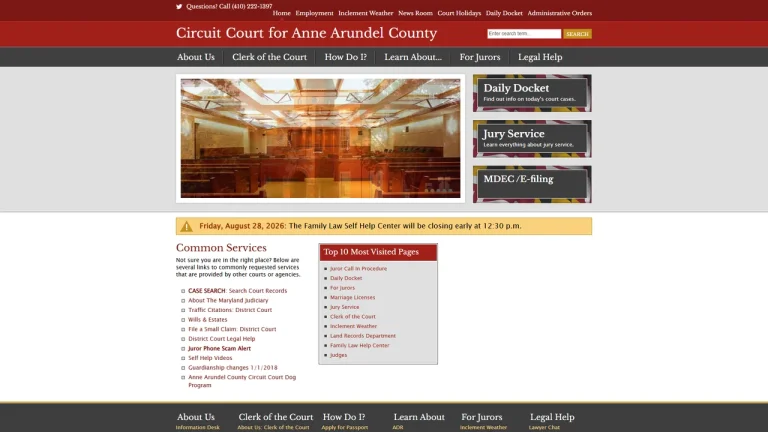
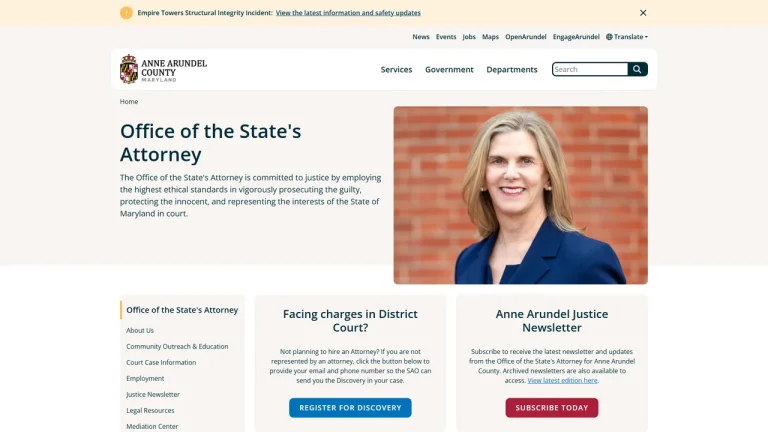
Office of the State's Attorney for Anne Arundel County - Annapolis, MD
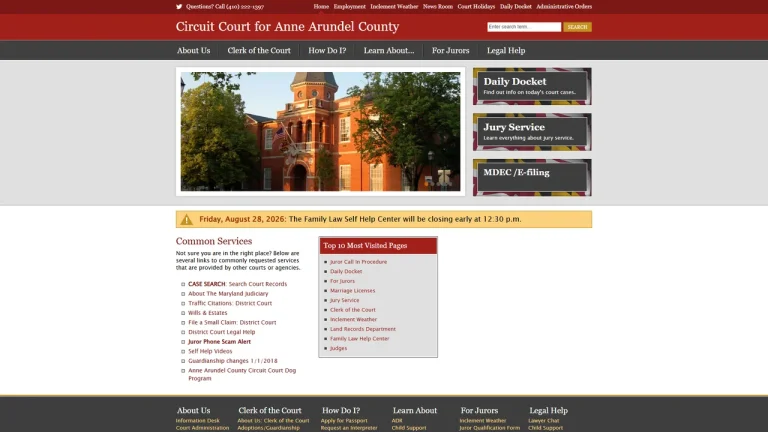
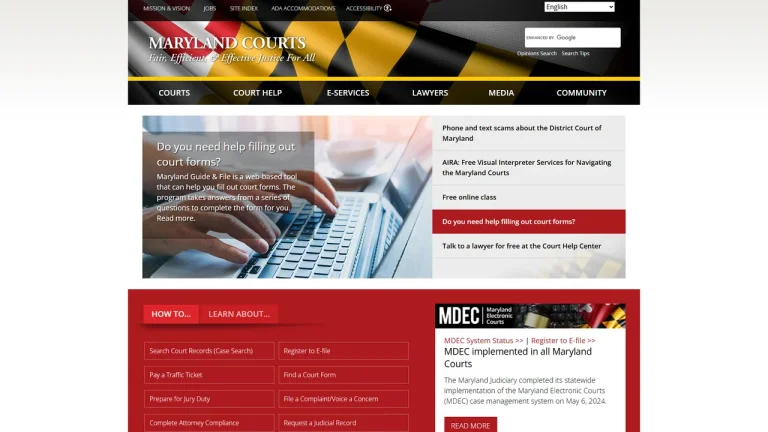
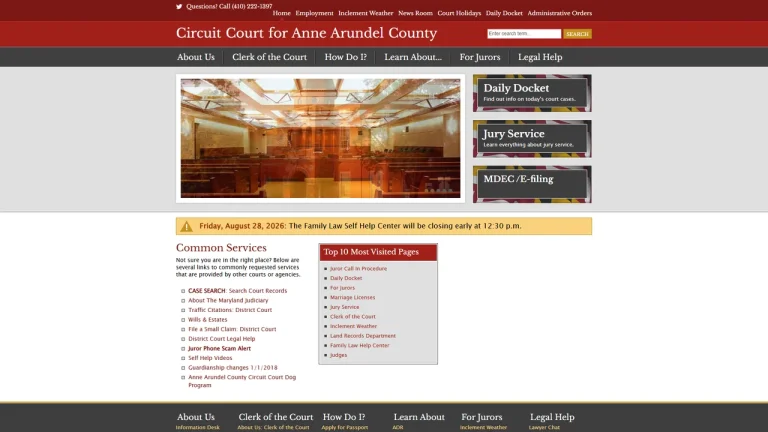
Maryland Judicial Structure and Trial Court Jurisdictions
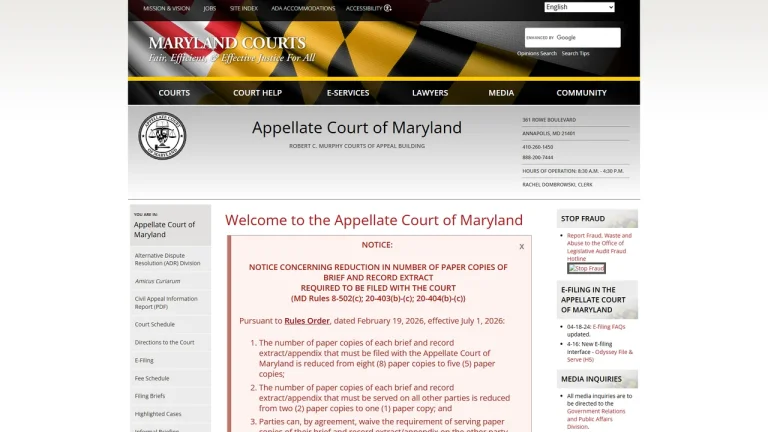
Maryland's court system operates across four primary levels, structured to adjudicate civil, criminal, and administrative matters originating throughout the state's twenty-three counties and Baltimore City. The Supreme Court of Maryland, located in Annapolis, serves as the state's court of last resort, possessing discretionary review authority over cases decided by the Appellate Court of Maryland. These appellate bodies ensure uniform interpretation of state statutory codes, civil rules, and constitutional provisions across all geographic circuits.
Trial-level matters are divided between the Circuit Courts and the District Court of Maryland. The Circuit Courts serve as the trial courts of general jurisdiction, organized into eight judicial circuits. Circuit Courts hold exclusive jurisdiction over jury trials, major civil claims exceeding $30,000, title disputes, and felony criminal prosecutions. Major regional judicial hubs include the Baltimore City Circuit Court in the Clarence M. Mitchell Jr. Courthouse, Montgomery County Circuit Court in Rockville, and Prince George's County Circuit Court in Upper Marlboro.
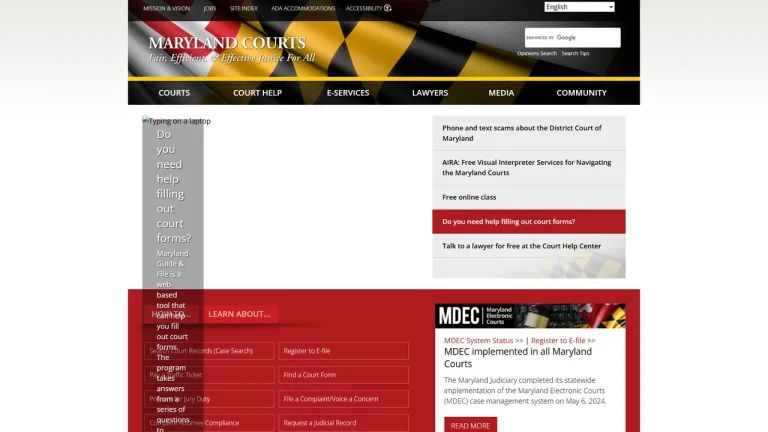
The District Court of Maryland is a single, statewide court operating across twelve judicial districts with thirty-three facilities. District Courts handle landlord-tenant disputes, motor vehicle violations, municipal ordinance infractions, misdemeanor offenses, and civil lawsuits where the disputed amount does not exceed $30,000. All official court filings, pleadings, and docket records are coordinated through the Maryland Electronic Courts (MDEC) system, accessible publicly via the Maryland Judiciary Case Search portal.
Statutory Court Fees, Core Filings, and Processing Schedules
| Service / Matter | Required Documents / Prerequisites | Statutory Fee (USD) | Processing Timeline |
|---|---|---|---|
| District Court Small Claims (Up to $5,000) | Form DC-CV-001 (Civil Complaint), supporting invoices/contracts, summons notice | $34 filing fee plus $10 per defendant service | 30 to 60 days to initial trial hearing |
| Circuit Court General Civil Filing | Complaint, Civil Non-Domestic Information Report (Form CC-DCM-002), MDEC filing entry | $165 standard civil docketing fee | 12 to 18 months through discovery and trial |
| Certified Judgment / Case Transcript | Written request, case docket number, verification of party or public access status | $5 to $10 per certified document copy | 3 to 7 business days from receipt |
| Notice of Appeal to Appellate Court | Notice of Appeal filed in Circuit Court, certificate of service, order transcript | $50 Circuit Court fee plus $110 appellate docketing fee | Strict 30-day statutory filing window |
Critical Legal Deadlines & Statutes in Maryland
Maryland enforces rigid statutory limitations and procedural timeframes that govern civil actions and administrative appeals. In general civil disputes, including breach of contract, negligence, and property damage, plaintiffs must commence action within three years from the date the cause of action accrues pursuant to Md. Code Ann., Cts. & Jud. Proc. § 5-101. For claims against state agencies or personnel, claimants must provide written administrative notice to the Maryland State Treasurer within one year of injury under the Maryland Tort Claims Act as mandated by Md. Code Ann., State Gov't § 12-106.
Appellate deadlines require immediate action upon the entry of a final judgment or appealable interlocutory order. An appellant must file a Notice of Appeal in the originating Circuit Court within thirty calendar days after the entry of judgment in accordance with Md. Rule 8-202. Summary landlord-tenant proceedings operate on accelerated schedules, where a tenant must be summoned at least five days prior to the hearing date and judgment warrants are executed pursuant to Md. Code Ann., Real Prop. § 8-401.
Direct Agency Access vs. Retaining Licensed Maryland Counsel
Individuals have the legal right to access Maryland state and local courts pro se for simplified matters, including small claims actions under $5,000, uncontested district citations, and routine public records requests under the Maryland Public Information Act pursuant to Md. Code Ann., Gen. Prov. § 4-101. District Court self-help centers provide instructional materials, standard forms, and procedural navigation for unrepresented litigants.
Conversely, retaining licensed Maryland legal counsel is essential when matters involve Circuit Court civil litigation, evidentiary hearings, criminal charges, or complex commercial claims. Under Maryland procedural law, business entities such as corporations and limited liability companies cannot represent themselves in Circuit Court proceedings and must appear through an attorney admitted to practice by the Supreme Court of Maryland. An experienced attorney protects procedural rights, conducts formal depositions, and navigates evidentiary burdens under the Maryland Rules of Evidence.
Procedural Pitfalls & Document Verification Alerts
- Unauthorized E-Filing Portals: Electronic filings must only be submitted through the official Odyssey MDEC system; third-party websites charging convenience fees do not have authority to docket pleadings in Maryland courts.
- Jurisdictional Venue Errors: Commencing an action in the incorrect county circuit or filing a claim exceeding $30,000 in the District Court can result in dismissal or mandatory venue transfer motions.
- Commercial Record Scams: Court dockets, case dispositions, and hearing calendars are publicly viewable on Maryland Judiciary Case Search; never pay commercial subscription websites for standard state case dockets.
- Strict Time-Bar Traps: Maryland courts enforce statutory deadlines strictly; failing to serve process within sixty days of summons issuance under Maryland rules can trigger administrative case dismissal.
Frequently Asked Questions
What is the monetary threshold between Maryland District Courts and Circuit Courts?
The District Court of Maryland maintains exclusive jurisdiction over civil claims up to $5,000 (small claims) and concurrent jurisdiction with the Circuit Courts for claims between $5,000 and $30,000. For civil claims exceeding $30,000, the Circuit Courts maintain exclusive subject-matter jurisdiction.
How do I inspect public court dockets in Maryland?
Public court records can be searched online using the Maryland Judiciary Case Search tool, which provides case numbers, parties, charges, disposition statuses, and scheduled hearing dates for both District and Circuit Court proceedings across the state.
Can an LLC or corporation appear without an attorney in Maryland?
In Maryland Circuit Courts, business corporations and limited liability companies are legally required to appear through licensed counsel. In the District Court of Maryland, designated officers or employees may represent a corporation only in small claims matters up to $5,000 under specific statutory exceptions.
What is the deadline to appeal a decision from a Maryland Circuit Court?
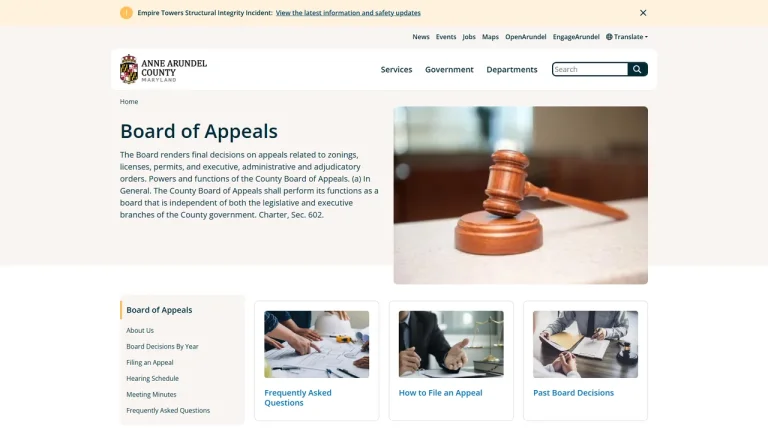
A party seeking to appeal a final judgment entered by a Maryland Circuit Court must file a formal Notice of Appeal in that same Circuit Court within thirty calendar days from the date the judgment is officially docketed.
How does the Maryland Electronic Courts (MDEC) system operate?
MDEC is the statewide electronic filing, case management, and record platform created by the Maryland Judiciary. Attorneys must submit all case pleadings through MDEC, while self-represented litigants can choose between electronic filing and paper submissions at the clerk's counter.