
Courts in Pennsylvania
Understanding the Pennsylvania Unified Judicial System is critical when accessing court dockets, filing actions, or monitoring appellate proceedings. Our statewide directory covers all four judicial tiers, from local Magisterial District Courts to the Supreme Court of Pennsylvania across all 60 judicial districts. Explore the verified listings below to find court coordinates, clerks, and online filing portals.
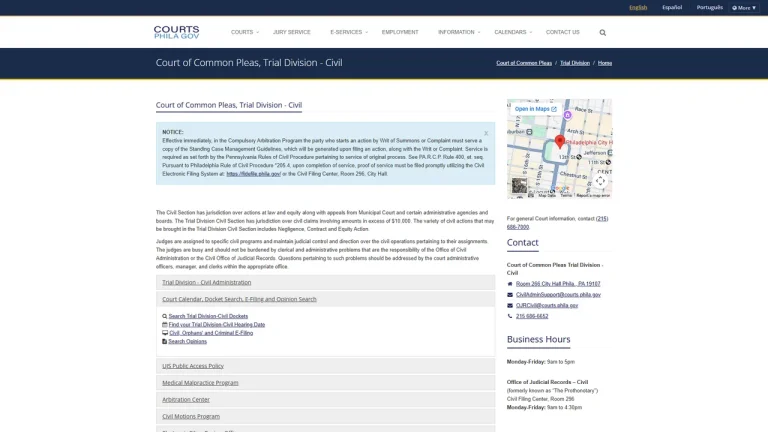
Philadelphia Civil Court - Philadelphia, PA


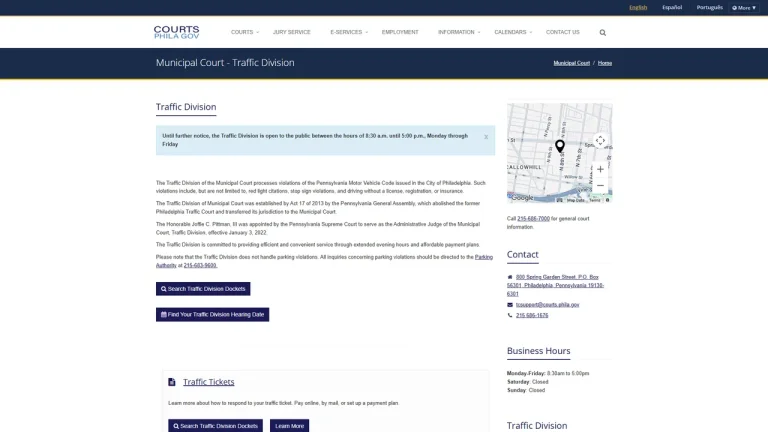
Philadelphia Municipal Court-Prothonotary - Philadelphia, PA

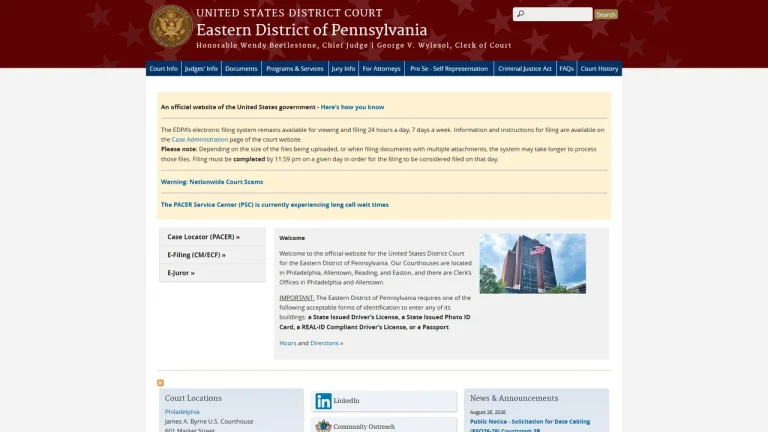
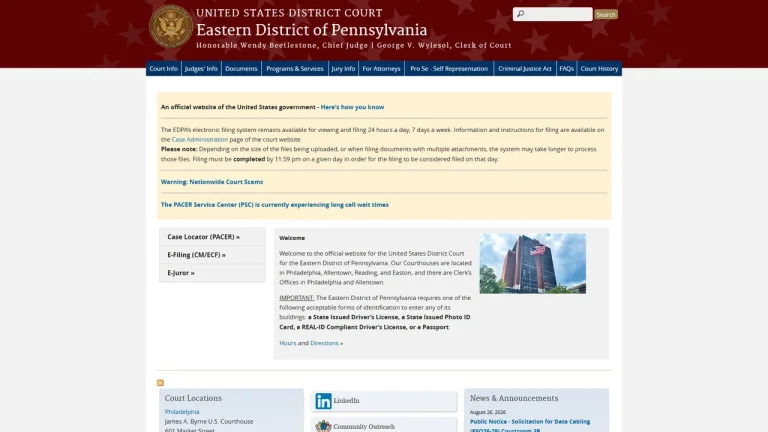
U.S. District Court for the Eastern District of Pennsylvania
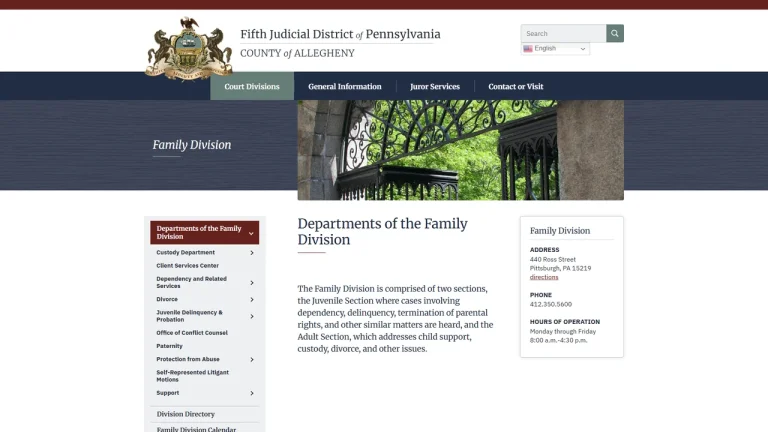
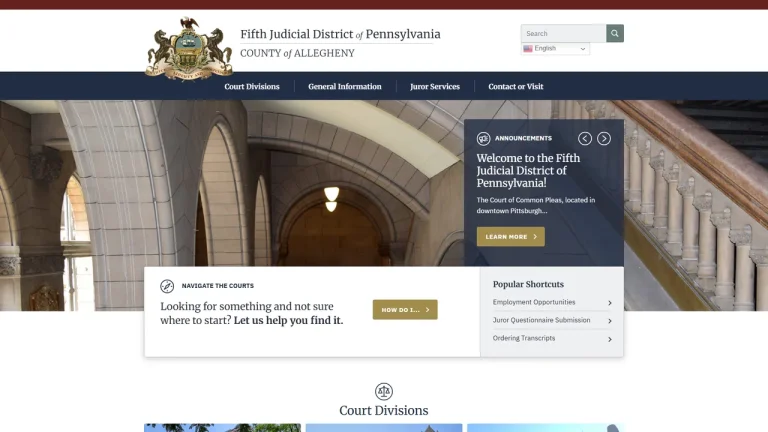
Judge Beth A. Lazzara - Court of Common Pleas - Pittsburgh, PA




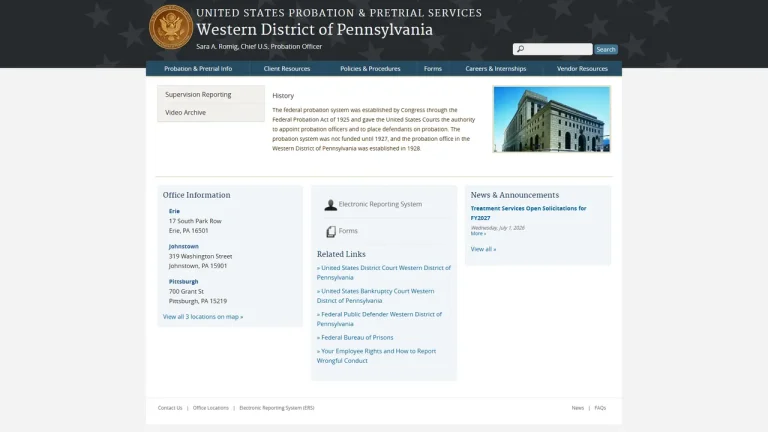
US Probation and Pretrial Services Office Western District of PA - Pittsburgh, PA
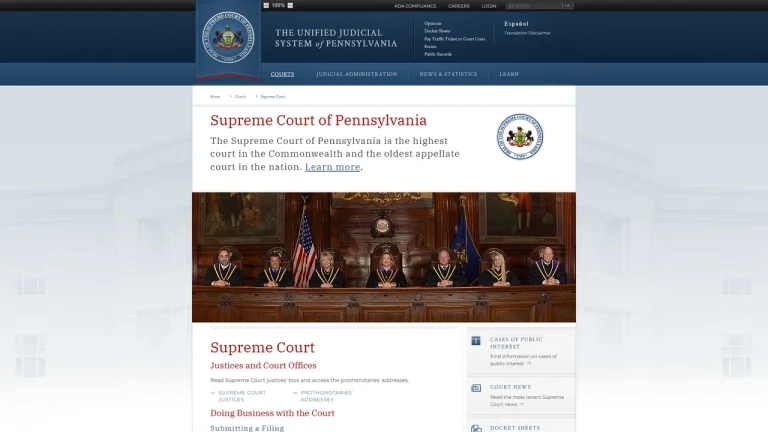
The Structure of the Pennsylvania Unified Judicial System
The Pennsylvania Unified Judicial System (UJS) is established under Article V of the Pennsylvania Constitution and is governed under the supervisory authority of the Supreme Court of Pennsylvania. The Commonwealth judicial branch is structured into four functional tiers: the Supreme Court (the ultimate court of last resort), two intermediate appellate courts (the Superior Court and Commonwealth Court), sixty county-based Courts of Common Pleas, and the minor courts.
Pennsylvania possesses a distinct intermediate appellate division. The Superior Court of Pennsylvania reviews criminal, family, and standard civil appeals arising from the Courts of Common Pleas. In contrast, the Commonwealth Court of Pennsylvania functions with specialized appellate and original jurisdiction, handling disputes involving state administrative departments, local government taxation, zoning disputes, and civil actions against Commonwealth agencies.
Trial-level jurisdiction is distributed across 60 judicial districts covering the Commonwealth's 67 counties. The Courts of Common Pleas are the primary trial courts of general jurisdiction, with specialized divisions for civil actions, felony criminal cases, orphans court (probate and estates), and family law matters. The minor judiciary consists of Magisterial District Courts throughout Pennsylvania and the Philadelphia Municipal Court, which manage summary criminal offenses, initial preliminary hearings, and small claims claims.
Pennsylvania Court Filings, Dockets and Statutory Fees
| Service / Matter | Required Documents / Prerequisites | Statutory Fee (USD) | Processing Timeline |
|---|---|---|---|
| Magisterial District Court Small Claims Filing | Civil complaint form, defendant address verification, claim under $12,000 | $60 - $135 (graduated by claim amount) | Hearing scheduled within 30 - 60 calendar days |
| Court of Common Pleas Civil Complaint / Praecipe | Standard civil cover sheet, verified complaint, PACFile e-filing submission | $175 - $380 (varies by county prothonotary) | Immediate docket entry via PACFile electronic filing |
| UJS Public Court Docket & Transcript Search | Case caption, participant name, or official docket number | Free online search ($15 - $30 for certified copy) | Instant electronic retrieval via UJS Web Portal |
| Notice of Appeal to Superior or Commonwealth Court | Notice of appeal, docketing statement, copy of Common Pleas final order | $90.25 appellate filing fee plus county transmission fee | Strict 30-day jurisdictional filing window |
Critical Legal Deadlines & Statutes in Pennsylvania
Procedural deadlines within the Pennsylvania Unified Judicial System are strictly construed and directly impact jurisdictional rights. Under 42 Pa. C.S. § 5571 and Pa. R.A.P. 903, a Notice of Appeal from a final order of a Court of Common Pleas to either the Superior Court or the Commonwealth Court must be filed within 30 days of the date the order is entered on the docket. Failure to file within this 30-day window results in an immediate, non-waivable dismissal of the appeal.
Appealing decisions from the minor judiciary requires prompt action. Under Pa. R.C.P.M.D.J. No. 1002, a party has 30 days from the date of a Magisterial District Court civil judgment to file an appeal with the prothonotary of the Court of Common Pleas. However, in residential landlord-tenant recovery proceedings, Pa. R.C.P.M.D.J. No. 1008 restricts the appeal timeframe to just 10 days to secure a supersedeas and halt eviction.
For initiating original civil actions in the Court of Common Pleas, Pennsylvania statutes of limitations enforce rigid cutoffs. Under 42 Pa. C.S. § 5524, plaintiffs have two years to initiate lawsuits for personal injury, negligence, and property damage. Written breach of contract claims must be commenced within four years pursuant to 42 Pa. C.S. § 5525.
Self-Representation (Pro Se) vs. Court Representation
Litigants have the legal right to represent themselves (proceed pro se) in minor court proceedings, such as Magisterial District Courts and the Philadelphia Municipal Court Small Claims Division. These lower courts feature streamlined procedures, relaxed evidentiary standards, and informal hearings designed to resolve disputes under the $12,000 statutory ceiling without mandatory legal representation.
Conversely, self-representation in the Courts of Common Pleas, the Superior Court, or the Commonwealth Court poses significant procedural risks. Litigants who proceed pro se are held to the same standard as admitted attorneys under the Pennsylvania Rules of Civil Procedure and local county court rules. Deficiencies such as failing to respond to preliminary objections, improperly executed verifications, or failing to preserve objections on the trial record regularly result in forfeiture of valid claims. Retaining an attorney admitted by the Supreme Court of Pennsylvania ensures proper use of the state PACFile electronic filing system and skilled courtroom advocacy.
Red Flags & Court Navigation Cautions
- Commercial Court Data Subscription Scams: Avoid private websites that charge recurring monthly fees to view Pennsylvania case dockets. The Pennsylvania Unified Judicial System provides free public access through its official portal (pacourts.us).
- Confusing County Prothonotaries with Clerks of Courts: In Pennsylvania, civil actions are managed by the Prothonotary, whereas criminal records are maintained by the Clerk of Courts. Submitting filings to the incorrect office can result in rejected pleadings and missed statutory filing deadlines.
- Non-Compliant Generic Court Templates: National boilerplate legal forms often lack mandatory Pennsylvania county local coversheets, formal verification language, and required confidentiality redaction certificates under the UJS Public Access Policy.
- Unlicensed Legal Filing Agents: Non-lawyers offering paid legal drafting or promising guaranteed outcomes in Pennsylvania courts are engaging in the unauthorized practice of law, which can compromise your litigation standing.
Frequently Asked Questions
What is the monetary limit for small claims court in Pennsylvania?
The jurisdictional limit for small claims matters in Pennsylvania Magisterial District Courts is $12,000. In Philadelphia County, the Philadelphia Municipal Court handles small claims civil disputes up to $12,000, as well as code enforcement claims up to $15,000.
What is the difference between the Superior Court and the Commonwealth Court?
Both are intermediate appellate courts, but they handle different subjects. The Superior Court hears general civil, criminal, and domestic relations appeals from the Courts of Common Pleas. The Commonwealth Court hears cases involving state and municipal government agencies, administrative appeals, and regulatory matters.
What is PACFile in the Pennsylvania court system?
PACFile is the official electronic filing service of the Pennsylvania Unified Judicial System. It permits attorneys and registered pro se litigants to file documents online with the Supreme Court, Superior Court, Commonwealth Court, and participating county Courts of Common Pleas.
Where do I file an appeal from a Magisterial District Court ruling?
Appeals from a Magisterial District Court judgment are filed with the Prothonotary (for civil matters) or the Clerk of Courts (for criminal summary matters) at the county Court of Common Pleas where the district court is situated, within 30 days of the judgment date.
How can the public access court records across Pennsylvania?
The public can review court dockets, case dispositions, and hearing calendars without charge by using the Pennsylvania Unified Judicial System Web Portal at ujsportal.pacourts.us, searching by participant name, docket number, or county jurisdiction.