
Federal Courts in Pennsylvania
Understanding federal courts in Pennsylvania is essential for navigating litigation across the Eastern, Middle, and Western Districts and the U.S. Court of Appeals for the Third Circuit. From filing federal civil rights actions to managing corporate bankruptcy dockets, strict adherence to federal procedural rules is required. Explore our directory below to locate regional federal courthouses, review filing portals, and connect with authorized judicial resources.
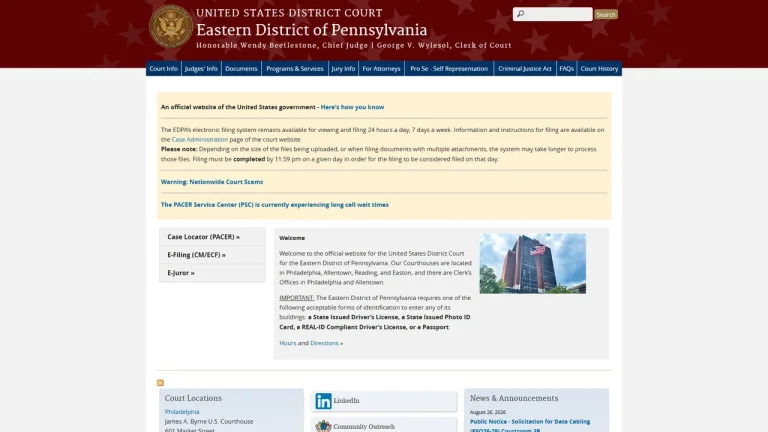
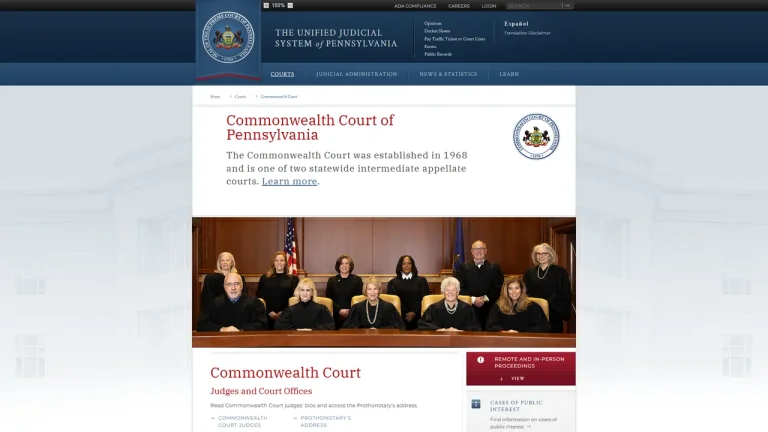
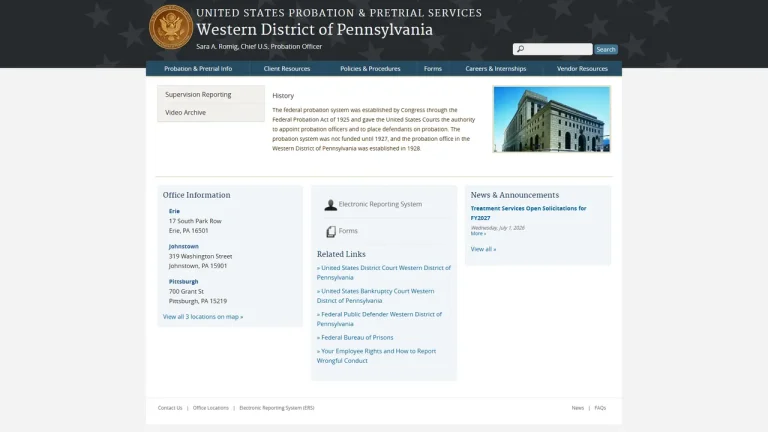
US Probation and Pretrial Services Office Western District of PA - Pittsburgh, PA
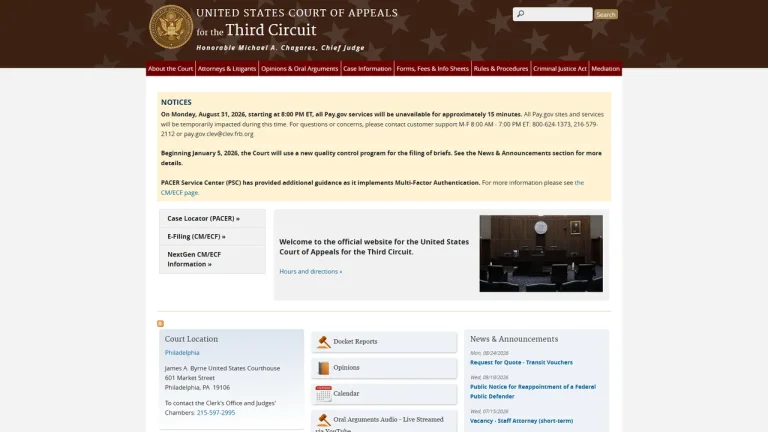
United States Court of Appeals for the Third Circuit - Philadelphia, PA

Federal Public Defender - Middle District of Pennsylvania - Harrisburg, PA
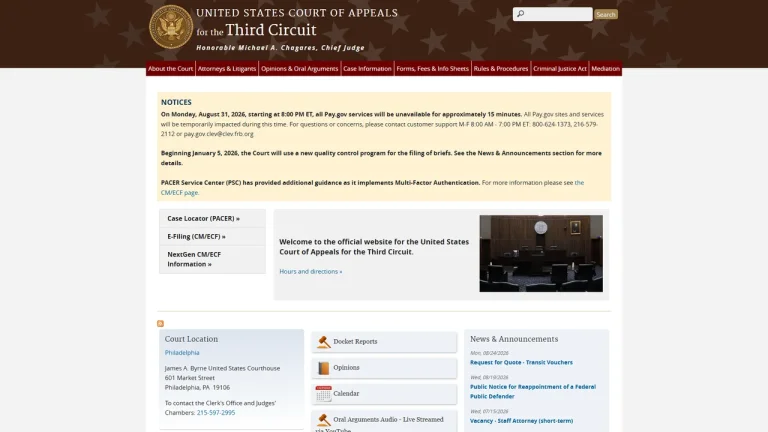
U.S. Court of Appeals for the Third Circuit - Philadelphia, PA

US Pretrial Services - Western District of Pennsylvania - Pittsburgh, PA
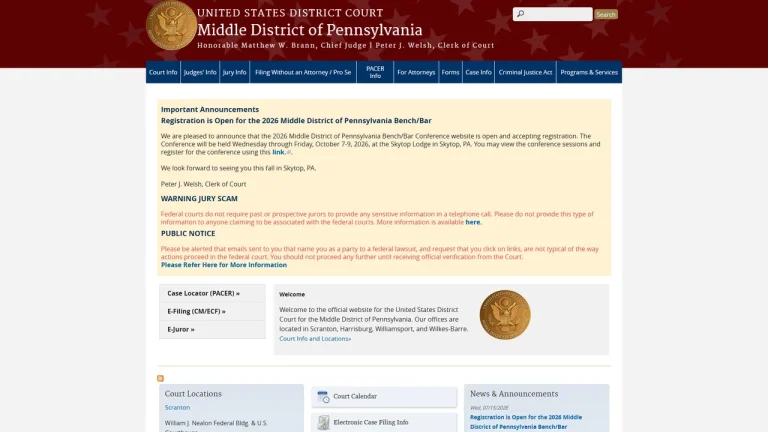
United States District Court - Middle District of Pennsylvania - Harrisburg, PA
US Department of Justice - U.S. Attorney's Office - Philadelphia, PA
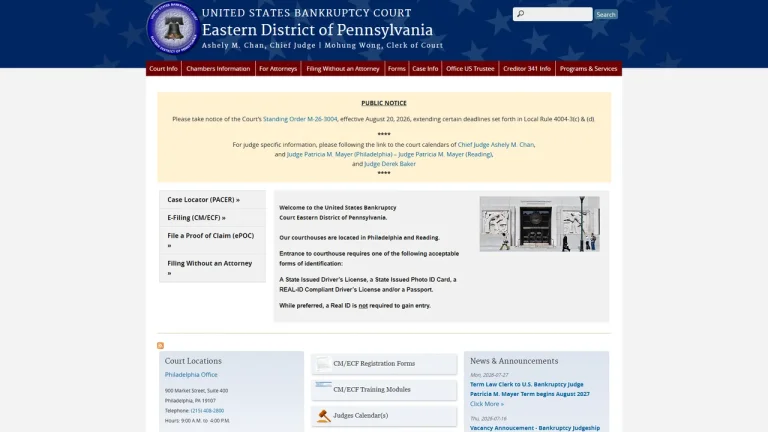
U.S. Bankruptcy Court for the Eastern District of Pennsylvania

Federal Judicial Architecture Across Pennsylvania
The federal judiciary in Pennsylvania is organized into three distinct United States District Courts operating under the appellate authority of the United States Court of Appeals for the Third Circuit, which is headquartered at the James A. Byrne U.S. Courthouse in Philadelphia. These courts exercise subject-matter jurisdiction over matters involving federal constitutional rights, federal statutory claims, interstate disputes under diversity of citizenship, and federal criminal prosecutions.
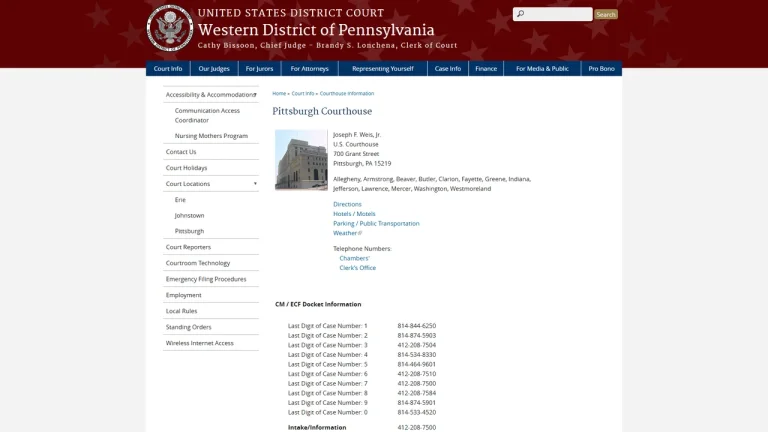
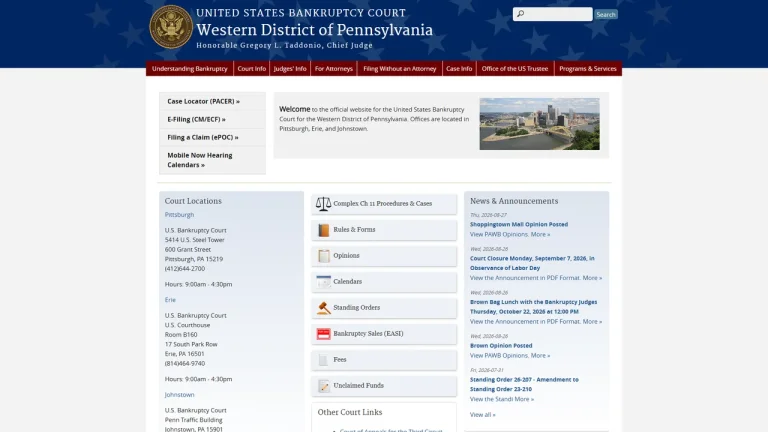
The United States District Court for the Eastern District of Pennsylvania (EDPA) maintains divisions in Philadelphia, Allentown, and Reading, serving nine southeastern counties. The Middle District of Pennsylvania (MDPA), operating from courthouses in Harrisburg, Scranton, Williamsport, and Wilkes-Barre, spans thirty-three central and northeastern counties. The Western District of Pennsylvania (WDPA) serves twenty-five western counties with judicial facilities in Pittsburgh, Erie, and Johnstown. Each district also features a dedicated United States Bankruptcy Court presiding over commercial and consumer debtor proceedings.
Federal litigation is subject to exacting procedural standards governed by the Federal Rules of Civil and Criminal Procedure, supplemented by extensive local district rules. Electronic case management and public document access across all Pennsylvania federal venues are coordinated through the federal CM/ECF and PACER networks.
Pennsylvania Federal Court Filing Schedules and Statutory Fees
| Service / Matter | Required Documents / Prerequisites | Statutory Fee (USD) | Processing Timeline |
|---|---|---|---|
| Civil Complaint Commencement | Summons, complaint, civil cover sheet (JS 44), disclosure statement | $405.00 ($350 filing + $55 administrative) | Immediate electronic docketing |
| Notice of Appeal to the Third Circuit | Notice of appeal filed in district court, fee remittance | $605.00 statutory appellate fee | Within 30 days of final judgment |
| Chapter 7 Bankruptcy Petition | Official bankruptcy petition, schedules, credit counseling certificate | $338.00 statutory filing fee | Immediate stay; discharge in 4 to 6 months |
| PACER Public Electronic Docket Access | Registered PACER account, case number or party name | $0.10/page ($3.00 cap; free if <$30/quarter) | Instantaneous online retrieval |
Critical Federal Court Deadlines & Statutes in Pennsylvania
Federal court proceedings enforce strict statutory timetables that admit few exceptions. In federal civil litigation, timing for appellate review is strictly controlled by Federal Rule of Appellate Procedure 4(a)(1)(A), which requires that a notice of appeal be filed in the district court within thirty days after entry of the final judgment or order appealed from, extended to sixty days if the United States government is a party.
Upon being served with a federal civil summons and complaint, a defendant must serve an answer or responsive motion within twenty-one days pursuant to Federal Rule of Civil Procedure 12(a)(1)(A). In federal criminal matters, statutory milestones are established by the federal Speedy Trial Act under 18 U.S. Code § 3161, which mandates that an indictment or information be filed within thirty days of an arrest, and that trial commence within seventy days from the filing date of the charging document or initial court appearance.
For collateral attacks on criminal judgments, the federal habeas corpus provisions of 28 U.S. Code § 2244 enforce an unyielding one-year statute of limitations for filing a petition for a writ of habeas corpus under 28 U.S. Code § 2254. Similarly, tort actions asserted against the federal government under the Federal Tort Claims Act must comply with 28 U.S. Code § 2401, requiring an administrative claim within two years of accrual and civil litigation within six months of agency denial.
Direct Agency Access vs. Legal Counsel
Pro se litigants have a statutory right to represent themselves in federal court under federal law, allowing individuals to review electronic dockets on PACER, attend public hearings in federal courthouses, or file individual consumer bankruptcy petitions. Pro se clinics and self-help resources are accessible through the clerk's offices in Philadelphia, Pittsburgh, Harrisburg, and Scranton.
However, navigating federal litigation without an attorney carries substantial risks. Federal judges enforce rigorous compliance with the Federal Rules of Evidence and Federal Rules of Civil Procedure. Furthermore, federal law does not permit corporations, LLCs, or partnerships to proceed pro se; business entities must be represented by licensed legal counsel. Retaining an attorney admitted to the bar of the Eastern, Middle, or Western District of Pennsylvania is essential for conducting formal discovery, drafting summary judgment motions, and presenting oral argument before the Third Circuit.
Procedural Pitfalls and Federal Litigation Warnings
- Avoid unauthorized commercial data portals that charge expensive recurring fees for federal court dockets; public records are accessible directly via PACER for a nominal fee per page.
- Do not miss the strict thirty-day jurisdictional deadline for filing a notice of appeal to the Third Circuit, as district judges cannot extend this timeline outside narrow statutory exceptions.
- Ensure strict compliance with the local civil rules of the specific Pennsylvania federal district, including page limits, mandatory meet-and-confer certifications, and specific motion formatting rules.
- Verify that any retained legal practitioner is formally admitted to the bar of the relevant federal district court or has secured proper admission pro hac vice.
Frequently Asked Questions
What three federal judicial districts cover Pennsylvania?
Pennsylvania is divided into the Eastern District (EDPA), based in Philadelphia, Allentown, and Reading; the Middle District (MDPA), based in Harrisburg, Scranton, Williamsport, and Wilkes-Barre; and the Western District (WDPA), based in Pittsburgh, Erie, and Johnstown.
Where does the U.S. Court of Appeals for the Third Circuit sit?
The Third Circuit Court of Appeals is headquartered in Philadelphia at the James A. Byrne U.S. Courthouse, 601 Market Street, hearing appeals from federal district courts in Pennsylvania, New Jersey, Delaware, and the U.S. Virgin Islands.
Can a corporation represent itself in Pennsylvania federal court?
No. Under established federal procedural law, corporate entities such as corporations, partnerships, and LLCs cannot appear pro se and must be represented by an attorney admitted to practice before the court.
How does PACER work for accessing Pennsylvania federal court records?
Public Access to Court Electronic Records (PACER) is an online system enabling users to search case dockets, retrieve filings, and view opinions from federal courts. Charges are capped at $3.00 per document, and quarterly usage under $30 is waived.
What is the difference between federal court and Pennsylvania state court jurisdiction?
Federal courts possess limited jurisdiction, hearing cases involving federal laws, the U.S. Constitution, federal crimes, or diversity of citizenship with claims exceeding $75,000. Pennsylvania state courts have general jurisdiction over state criminal, family, tort, and contract disputes.