
State Law Enforcement in Harrisburg
State law enforcement agencies headquartered in Harrisburg command statewide regulatory and investigative authority across Pennsylvania. From the Pennsylvania State Police headquarters to the Office of Attorney General in Strawberry Square, state agencies enforce criminal statutes and consumer protection laws. Explore our verified state law enforcement directory below to locate agency headquarters, reporting divisions, and specialized investigative units.
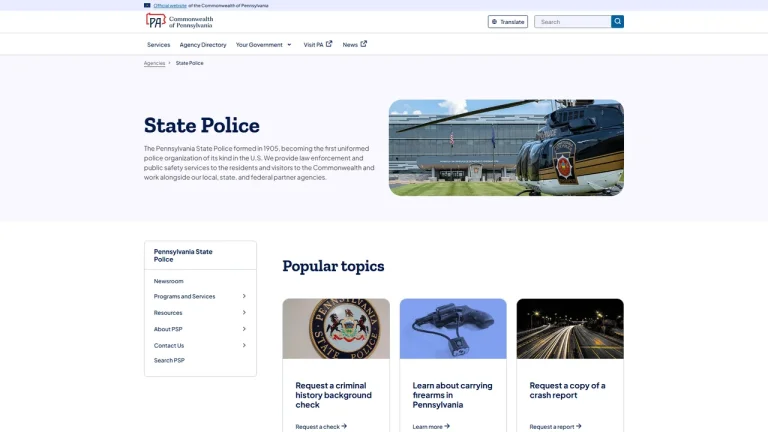
Pennsylvania State Police Bureau of Emergency and Special Operations - Harrisburg, PA
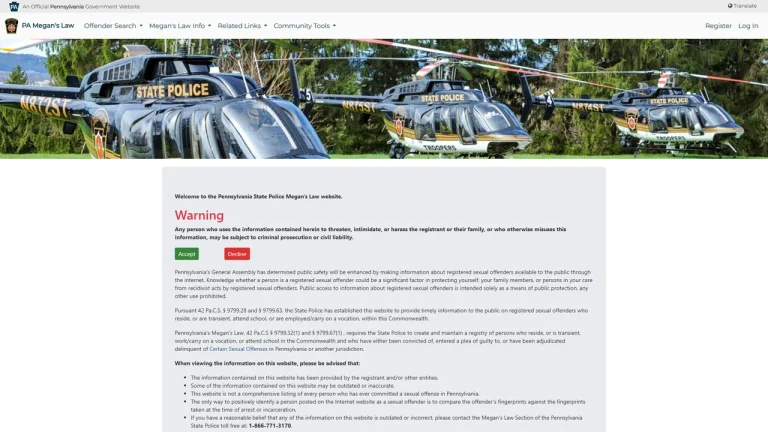

PSP Bureau of Integrity and Professional Standards - Harrisburg, PA

Statewide Police Authority and Executive Commands in Harrisburg
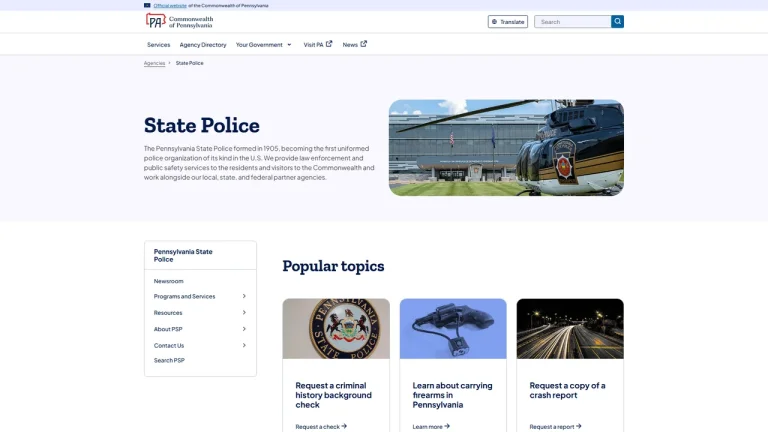
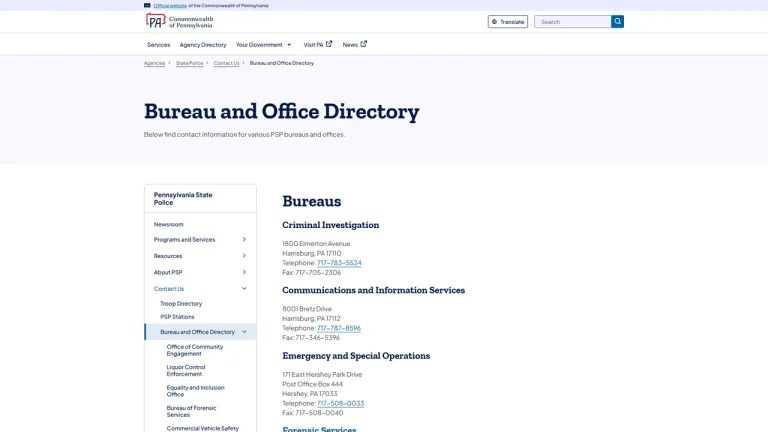
As the seat of Pennsylvania state government, Harrisburg serves as the command hub for the Commonwealth's primary statewide law enforcement, regulatory, and prosecutorial agencies. The Pennsylvania State Police (PSP) maintains its Bureau Headquarters at 1800 Elmerton Avenue in Harrisburg. PSP oversees statewide highway safety, forensic laboratory testing, the Bureau of Criminal Investigation (BCI), and specialized operational units, while Troop H Headquarters-also on Elmerton Avenue-provides direct regional coverage for Dauphin County and surrounding mid-state corridors.
Executive criminal investigations and prosecutorial actions are directed by the Office of Attorney General (OAG), based at Strawberry Square on the 16th Floor in downtown Harrisburg. The Attorney General exercises jurisdiction over statewide grand juries, public integrity probes, antitrust enforcement, Medicaid fraud, and complex narcotics syndicates under Commonwealth statutes.
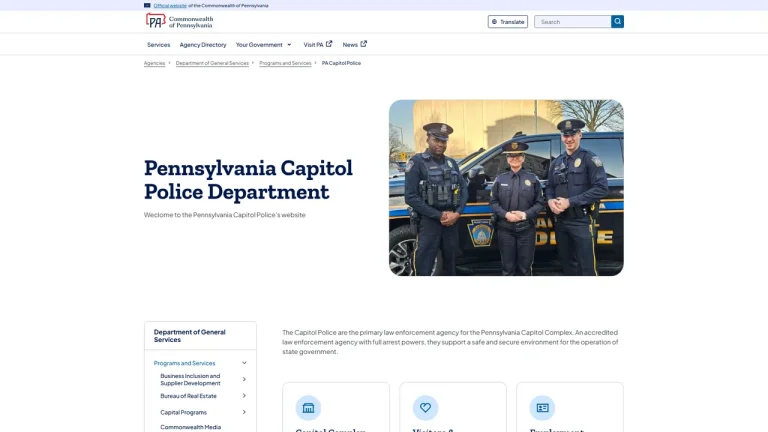
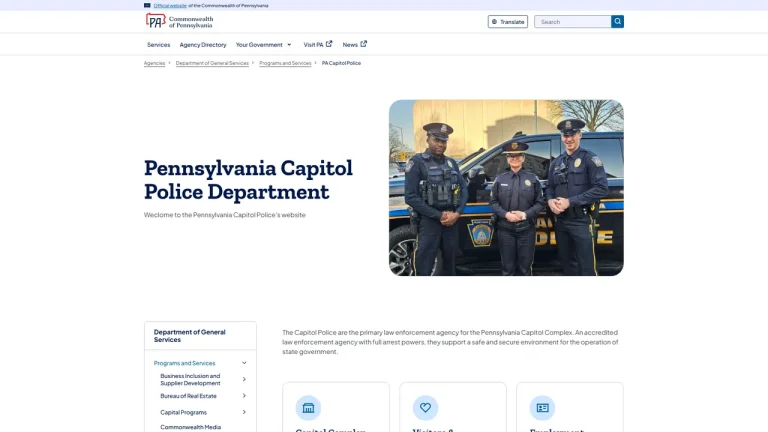
Specialized enforcement within state-owned facilities is provided by the Pennsylvania Capitol Police, operating from 70E Capitol East Wing under the Department of General Services. The Capitol Police maintains exclusive jurisdiction over the Pennsylvania State Capitol Complex, Capitol Annex, and designated state office buildings throughout Harrisburg.
Key State Agency Services, Prerequisites, and Regulatory Fees
| Service / Matter | Required Documents / Prerequisites | Statutory Fee (USD) | Processing Timeline |
|---|---|---|---|
| PSP Certified Criminal History Record (PATCH) | Subject full legal name, date of birth, Social Security number, online request | $22 statutory state processing fee | Immediate electronic search, 2 to 3 weeks mail |
| PSP Crash / Collision Investigation Report | Incident number, date of crash, involved driver identification, form SP 7-0015 | $22 statutory report fee | 10 to 15 business days |
| Attorney General Consumer Protection Complaint | Detailed written narrative, copies of contracts, payment receipts, vendor details | $0 state administrative fee | 15 to 30 business days evaluation |
| State Law Enforcement RTKL Records Request | Uniform Pennsylvania RTKL request form identifying specific agency records | $0.25 per page copying fee (electronic copies free) | 5 business days statutory initial response |
Critical Legal Deadlines & Statutes in Pennsylvania
State law enforcement procedures and actions in Harrisburg operate under strict statutory frameworks. The statewide police powers of the Pennsylvania State Police are codified under the Administrative Code of 1929 at 71 P.S. § 250, conferring comprehensive authority to enforce the Pennsylvania Crimes Code (18 Pa. C.S. § 101) and Vehicle Code (75 Pa. C.S. § 101) across all Commonwealth jurisdictions.
Investigative and prosecutorial powers of the Pennsylvania Attorney General are governed by the Commonwealth Attorneys Act 71 P.S. § 732-205, granting jurisdiction over multi-county criminal enterprises, corrupt organizations under 18 Pa. C.S. § 911, and matters referred by state department heads or investigated by statewide investigating grand juries convened under 42 Pa. C.S. § 4543.
Claims against the Commonwealth of Pennsylvania, the State Police, or state troopers are subject to sovereign immunity under 1 Pa. C.S. § 2310 and 42 Pa. C.S. § 8521. For actions falling within statutory exceptions to sovereign immunity set forth in 42 Pa. C.S. § 8522, claimants must serve a formal written Notice of Intention to File a Claim with the Office of Attorney General within 6 months of the incident pursuant to 42 Pa. C.S. § 5522(a). Civil actions must be commenced within 2 years under 42 Pa. C.S. § 5524. Public records requests to state agencies follow the 5-day statutory timeline under the Pennsylvania Right-to-Know Law 65 P.S. § 67.901.
Direct Citizen Engagement vs. Retaining Legal Counsel
Citizens can engage directly with state law enforcement authorities for routine administrative needs. Submitting an application for a Pennsylvania Access to Criminal History (PATCH) background clearance, filing a consumer fraud complaint with the Attorney General's Bureau of Consumer Protection, reporting consumer scams, or obtaining a State Police vehicle collision report does not require legal representation.
Conversely, when an individual or corporate entity is the subject of a state grand jury subpoena, target letter, or investigation by the PSP Bureau of Criminal Investigation or the Attorney General's Criminal Law Division, retaining experienced defense counsel is essential. Witnesses summoned before a grand jury must carefully navigate self-incrimination protections under Article I, Section 9 of the Pennsylvania Constitution; unrepresented testimony risks perjury charges under 18 Pa. C.S. § 4902 or direct criminal indictment. An attorney admitted to practice before the Supreme Court of Pennsylvania ensures immunity agreements are secured, subpoenas duces tecum are evaluated, and constitutional rights are guarded.
Red Flags and State Agency Impersonation Scams
- Be vigilant against deceptive phone calls or emails claiming to represent the Pennsylvania State Police or Office of Attorney General threatening arrest unless funds are immediately sent via prepaid cards, wire transfers, or cryptocurrency.
- Do not pay elevated processing fees to private third-party websites claiming to expedite PATCH criminal background checks; official background checks can be submitted directly through the official PSP PATCH portal for the statutory $22 fee.
- Never surrender sensitive financial documents or answer investigatory inquiries from self-proclaimed state investigators without verifying their credentials through official agency switchboards in Harrisburg.
- Avoid signing consent-to-search forms or providing voluntary statements during State Police investigations without prior consultation with a qualified Pennsylvania criminal defense attorney.
Frequently Asked Questions
Where is the headquarters of the Pennsylvania State Police located?
The Pennsylvania State Police Department Headquarters is located at 1800 Elmerton Avenue in Harrisburg, housing executive commands, forensic divisions, and the Bureau of Criminal Investigation.
What is the jurisdiction of the Pennsylvania Capitol Police in Harrisburg?
Operating from 70E Capitol East Wing, the Pennsylvania Capitol Police provides primary law enforcement and security services for the State Capitol Complex and state-owned government buildings across Harrisburg.
What types of cases does the Pennsylvania Office of Attorney General prosecute?
Under 71 P.S. § 732-205, the Attorney General investigates and prosecutes multi-county criminal enterprises, public corruption, Medicaid fraud, consumer protection violations, and cases referred due to local district attorney conflicts.
How do I obtain an official criminal background check in Pennsylvania?
Criminal history record checks are obtained through the Pennsylvania State Police PATCH system (Pennsylvania Access To Criminal History) online or by submitting Form SP 4-164 for a statutory fee of $22.
What is the deadline to file a claim against the Pennsylvania State Police?
Under 42 Pa. C.S. § 5522(a), claimants must file a written Notice of Intention to File a Claim with the Office of Attorney General within 6 months of the incident giving rise to the injury.
Can the Pennsylvania Attorney General take over a case from the Dauphin County District Attorney?
Under the Commonwealth Attorneys Act (71 P.S. § 732-205), the Attorney General can prosecute local criminal cases upon formal referral from the Dauphin County District Attorney or by order of the court where a conflict exists.