
Business Filing & Licensing in Vermont
Establishing and maintaining a business entity in Vermont requires formal registration with the Secretary of State and compliance with state licensing bodies. Fulfilling statutory filing requirements safeguards limited personal liability and secures legal standing across the state. Browse our directory below to connect with official filing divisions, municipal clerks, and experienced commercial attorneys.

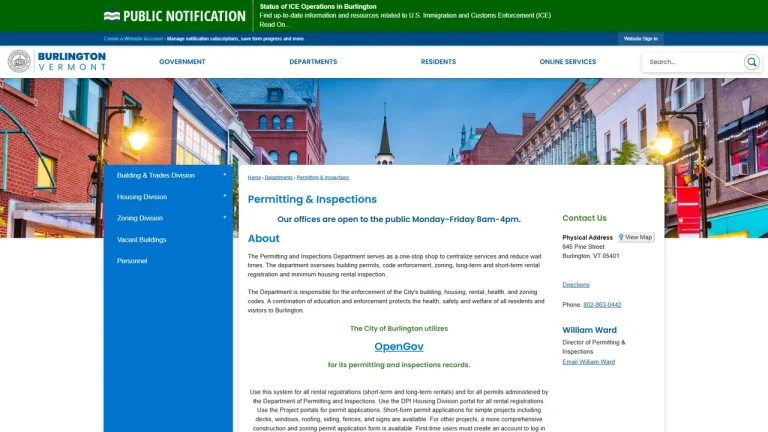
Burlington Department of Permitting and Inspections - Burlington, VT




Corporations and Business Services Division, Secretary of State - Montpelier, VT
Commercial Registration and Corporate Authority in Vermont
In Vermont, commercial enterprise formation, public entity registrations, and business licensing are administered centrally by the Vermont Secretary of State Corporations and Business Services Division, located in Montpelier. Whether establishing a limited liability company in Burlington, organizing a business corporation in South Burlington, or launching commercial operations in Rutland, Barre, or Brattleboro, entities must complete formal registration with the Secretary of State to secure authorized legal standing to conduct business.
Commercial compliance in Vermont requires coordination across multiple state departments. The Vermont Department of Taxes oversees corporate income taxes, sales and use taxes, and meals and rooms taxes through its centralized myVTax online system. Regulated professions and commercial occupations are governed by the Office of Professional Regulation within the Secretary of State, which licenses and oversees dozens of professional fields. Ensuring all state tax and professional licensing obligations are fulfilled maintains an enterprise active good standing.
In addition to state-level filings, businesses must comply with local municipal requirements administered by Town Clerks across Vermont 251 cities and towns. Municipalities routinely require local merchant licenses, municipal permits, and approvals from the local board of civil authority for liquor or entertainment venues. Understanding both state and municipal administrative obligations protects owners from corporate veil piercing and preserves commercial authority in Vermont courts.
Standard Business Filings, Prerequisites, and Statutory Fees in Vermont
| Service / Matter | Required Documents / Prerequisites | Statutory Fee (USD) | Processing Timeline |
|---|---|---|---|
| Domestic LLC Articles of Organization | Articles of Organization, designated registered agent in Vermont, principal office street address | $125.00 statutory filing fee | Immediate online; 3-5 business days paper |
| Domestic Articles of Incorporation | Articles of Incorporation, authorized share count, incorporator identity, registered agent | $125.00 statutory filing fee | 1-2 business days online |
| Domestic LLC Annual Report Filing | Entity ID number, verified Vermont registered agent, current principal street address | $35.00 statutory annual fee | Immediate electronic confirmation |
| Assumed Business Name (Trade Name / DBA) | Trade Name application form, registrant legal identity, business description | $50.00 statutory fee (valid for 5 years) | 1-3 business days online |
Critical Legal Deadlines & Statutes in Vermont
Maintaining active corporate standing in Vermont requires strict adherence to statutory filing schedules set forth in the Vermont Statutes Annotated. Under the Vermont Limited Liability Company Act, codified at 11 V.S.A. § 4013, a domestic or foreign LLC must file an annual report with the Secretary of State within two and a half months following the close of its fiscal year. For calendar-year companies, this annual report is due between January 1 and March 15. If an entity fails to file within sixty days after the due date, it is subject to administrative termination under 11 V.S.A. § 4101, resulting in the loss of corporate protections.
For assumed business names, 11 V.S.A. § 1623 establishes that trade name registrations remain valid for five years and must be renewed within sixty days prior to expiration to maintain registration rights. Corporate entities organized under the Vermont Business Corporations Act must satisfy formation requirements under 11A V.S.A. § 2.02. Furthermore, commercial enterprises undergoing physical construction or substantial changes in use must comply with state land use permitting deadlines under Act 250 pursuant to 10 V.S.A. § 6081 before initiating development.
Direct Agency Access vs. Legal Counsel
Entrepreneurs can manage standard business filings directly through state online portals without retaining an attorney. Registering a standard single-member LLC, renewing an assumed business name, filing mandatory annual reports, ordering a Certificate of Good Standing from the Secretary of State, and registering for state tax accounts on the Department of Taxes myVTax system are designed for direct public administration.
However, retaining an experienced Vermont business attorney is essential when structuring complex commercial ventures. Legal counsel is necessary when drafting comprehensive multi-member operating agreements with buy-sell provisions, negotiating equity financing, resolving shareholder oppression disputes in the Vermont Superior Court Civil Division, structuring commercial asset acquisitions, or navigating complex Act 250 land use permits before regional district environmental commissions under 10 V.S.A. § 6085.
Red Flags & Business Licensing Pitfalls
- Misleading Corporate Compliance Solicitations: Beware of private companies mailing letters demanding $125 to $175 for non-existent mandatory state corporate minutes. The Secretary of State requires only a standard online annual report and a $35 statutory fee for domestic LLCs.
- Non-Compliant Registered Agents: Appointing a registered agent who lacks a physical street address in Vermont risks missed court notices and administrative dissolution. Registered agents must be physically present in the state.
- Confusing Trade Names with Legal Entity Protection: Registering an assumed business name (DBA) does not create personal liability shielding; limited liability protection requires formal entity organization as an LLC or corporation.
- Overlooking Act 250 Permitting Requirements: Initiating commercial property development without evaluating Act 250 environmental jurisdiction can lead to severe stop-work orders and administrative penalties.
Frequently Asked Questions
Where are business entity documents filed in Vermont?
Business formation documents, including Articles of Organization and Articles of Incorporation, must be filed directly with the Vermont Secretary of State Corporations Division in Montpelier.
What is the annual report deadline for a Vermont LLC?
A Vermont limited liability company must file its annual report within two and a half months following the close of its fiscal year, which is between January 1 and March 15 for calendar-year businesses.
How long is an assumed business name (DBA) registration valid in Vermont?
An assumed business name or trade name registration is valid for five years from the date of filing and must be renewed within sixty days prior to its expiration date.
Can an owner serve as their own registered agent in Vermont?
Yes, any individual owner or officer who is a resident of Vermont and maintains a physical street address within the state may serve as the official registered agent for the entity.
When should a business hire a commercial attorney in Vermont?
Retaining an attorney is advised when drafting customized multi-member operating agreements, negotiating commercial leases, executing asset purchases, or navigating Act 250 environmental land use permitting.