
Courts in Vermont
Access official directories, filing procedures, and court calendars for the Vermont Supreme Court, county Superior Court units, and the Judicial Bureau. Understanding jurisdictional limits, electronic docketing rules, and statutory pleading deadlines ensures effective participation in state judicial proceedings. Explore our verified judicial directory below to locate Vermont courthouses or consult licensed local counsel.

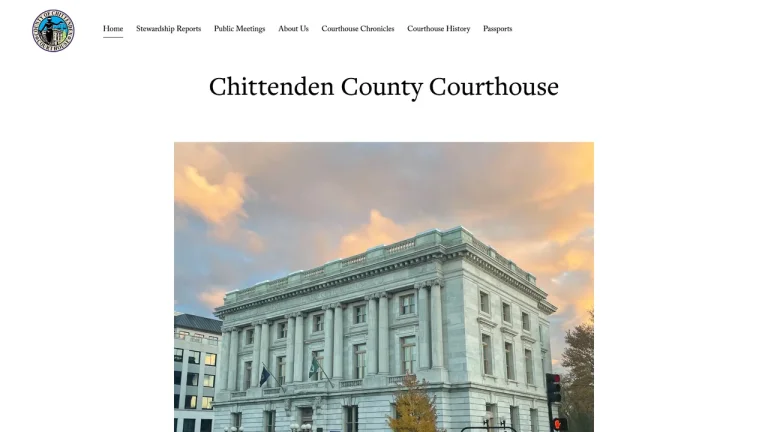
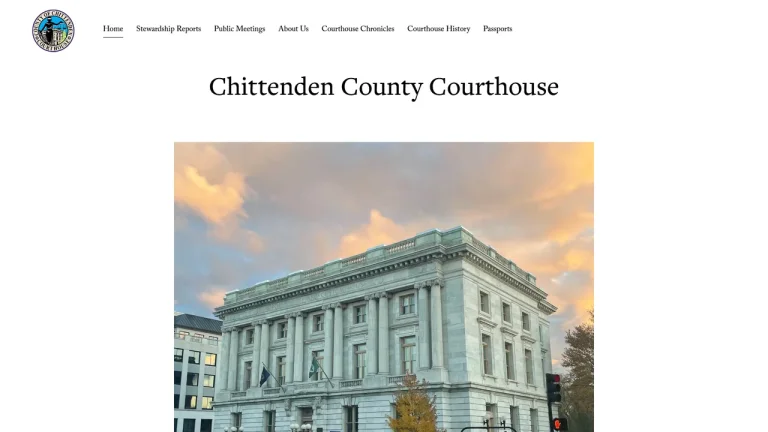
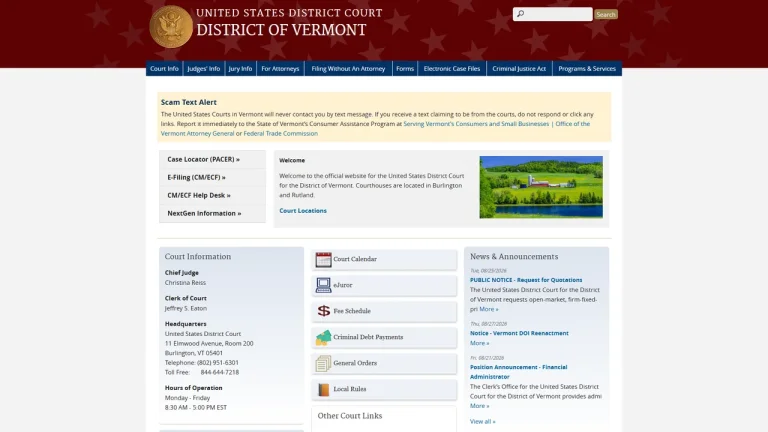
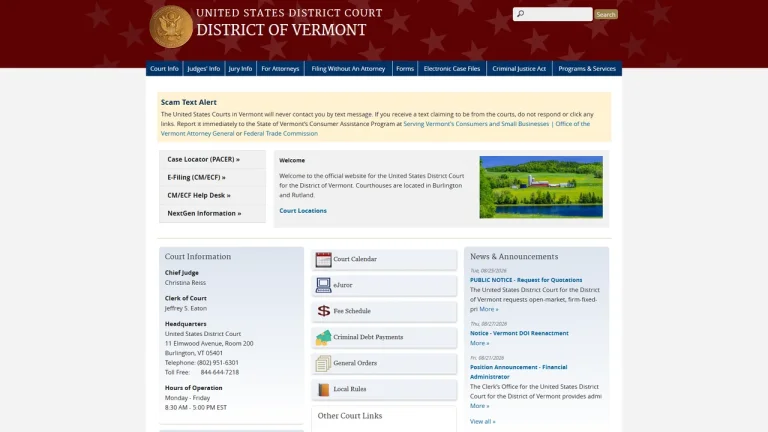
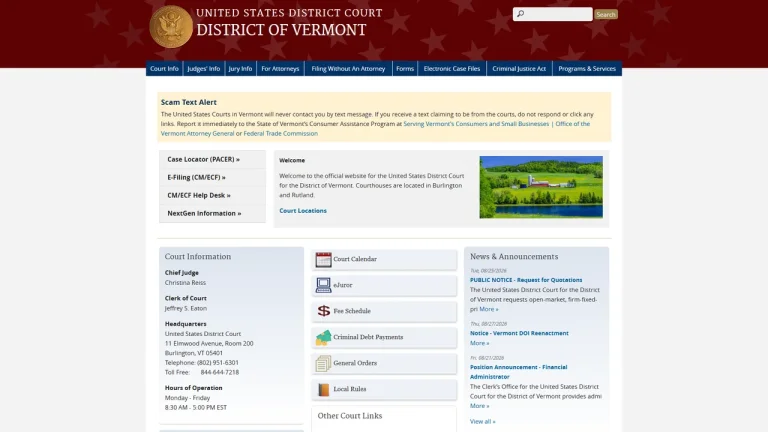
United States District Court - District of Vermont - Burlington, VT
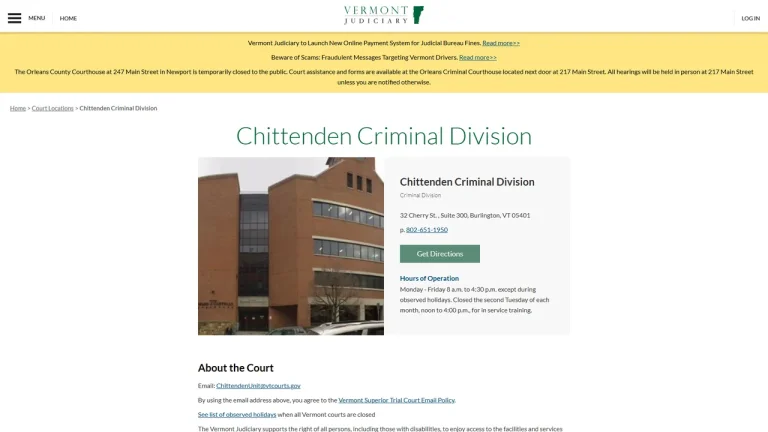
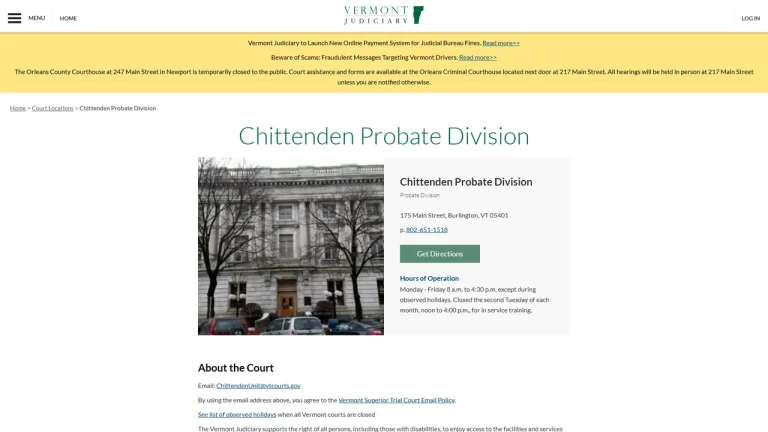
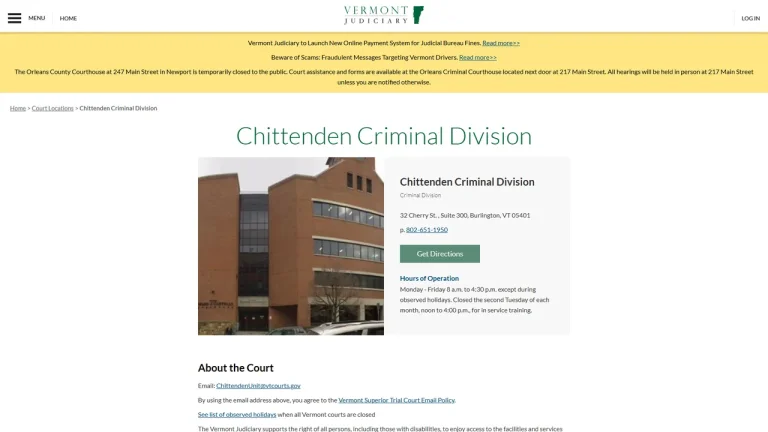
The Unified Judicial System and Court Structure of Vermont
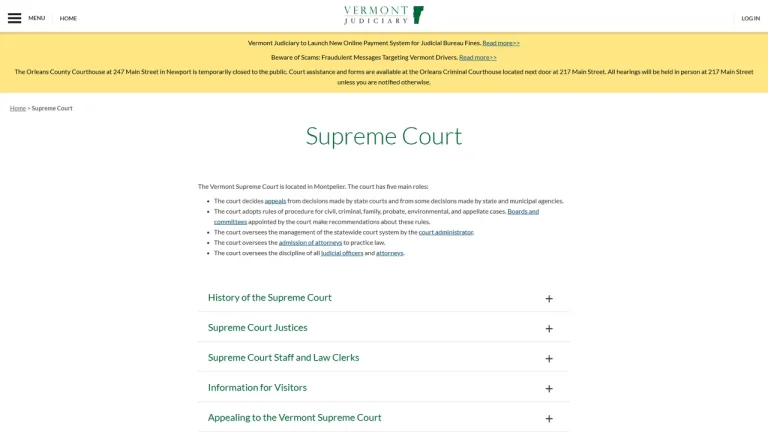
Judicial authority across the Green Mountain State is structured under a unified court system established by Chapter II of the Vermont Constitution. The Supreme Court of Vermont, situated in Montpelier, serves as the state court of last resort. Composed of the Chief Justice and four Associate Justices, the Supreme Court exercises final appellate jurisdiction over all legal matters arising from trial courts and maintains general administrative supervision over the entire judicial branch.
Trial-level jurisdiction resides primarily within the Vermont Superior Court, which operates across fourteen geographic units corresponding to Vermont fourteen counties. Major trial hubs include the Chittenden Unit in Burlington, the Rutland Unit in Rutland, the Washington Unit in Montpelier and Barre, the Windsor Unit in White River Junction, and the Windham Unit in Brattleboro. Under 4 V.S.A. § 31, the Superior Court is organized into five specialized functional divisions: the Civil Division, the Criminal Division, the Family Division, the Environmental Division, and the Probate Division.
Specialized administrative and minor violations fall under the statewide jurisdiction of the Vermont Judicial Bureau pursuant to 4 V.S.A. § 1102. The Judicial Bureau adjudicates civil traffic violations, municipal ordinance infractions, fish and wildlife violations, and state cannabis or alcohol civil offenses. Case management, public docket inquiries, and electronic filings across all Superior Court units are administered through the Odyssey File and Serve platform and the Vermont Judiciary Public Portal.
Vermont Court Filing Requisites, Fees, and Docket Timelines
| Service / Matter | Required Documents / Prerequisites | Statutory Fee (USD) | Processing Timeline |
|---|---|---|---|
| Superior Court Civil Action Filing | Civil complaint, summons, completed court information sheet, appearance form | $295.00 statutory state civil filing fee | Immediate electronic filing timestamp |
| Small Claims Procedure Filing | Small Claims Complaint (claims up to $5,000), supporting invoice documentation | $65.00 to $125.00 tiered by claim value | Hearing set within 30 to 60 calendar days |
| Family Division Domestic Filing (Divorce) | Complaint for divorce, domestic information form, financial affidavit | $295.00 statutory filing fee ($90 if stipulated) | Case conference set within 30 to 45 days |
| Certified Court Record or Decree | Written request, case docket number, party names, identification | $10.00 per certified copy plus page fees | 1 to 3 business days |
Critical Legal Deadlines & Statutes in Vermont
Civil litigation and court actions in Vermont are governed by statutory limitations set forth in Title 12 of the Vermont Statutes Annotated. General civil actions, including breach of written contracts and general property claims, are subject to a six-year statute of limitations pursuant to 12 V.S.A. § 511. However, claims for personal injury and damage to personal property must be commenced within three years from the date the cause of action accrues under 12 V.S.A. § 512, and wrongful death claims must be filed within two years from the date of death pursuant to 14 V.S.A. § 1492.
Procedural responses in Vermont Superior Courts are strictly timed under the Vermont Rules of Civil Procedure. When a defendant is formally served with a summons and complaint, V.R.C.P. 12(a)(1) requires that a written answer or motion be served within twenty-one calendar days after service of process, or the party risks entry of default under V.R.C.P. 55. For appellate review, a notice of appeal challenging a final judgment of the Superior Court must be filed with the trial court clerk within thirty calendar days from the date of judgment entry pursuant to V.R.A.P. 4(a). Small claims actions are capped at a monetary jurisdictional maximum of $5,000 under 12 V.S.A. § 5531.
Small Claims Self-Representation vs. Retaining Admitted Counsel
The Small Claims procedure within the Vermont Superior Court Civil Division is structured to provide an economical forum for self-represented litigants. Designed for claims not exceeding $5,000 under 12 V.S.A. § 5531, small claims hearings are conducted before small claims acting judges or magistrates. Formal rules of evidence are relaxed, and citizens can resolve consumer complaints, unpaid invoices, or security deposit disputes directly without hiring an attorney.
Conversely, civil actions exceeding the $5,000 small claims limit, complex real estate disputes, contested probate litigation, and matters in the Criminal or Family Divisions require the representation of an admitted Vermont attorney. Navigating the Civil Division involves mandatory compliance with the Vermont Rules of Civil Procedure, complex written discovery, and pretrial depositions. In the Family Division, high-stakes child custody decisions, parental rights disputes, and the equitable division of marital assets require experienced counsel to protect legal rights and ensure compliance with statutory guidelines.
Red Flags and Deceptive Court Services Intermediaries
- Commercial website portals charging recurring monthly access fees for public court dockets that are available to the public for free via the Vermont Judiciary Public Portal.
- Unregulated online document mills providing non-conforming legal templates that fail to satisfy mandatory Vermont Superior Court electronic filing standards.
- Imposter telephone callers falsely asserting an outstanding bench warrant issued by a Vermont county court demanding immediate payments via wire transfers or gift cards.
- Private process servers operating outside the statutory personal service rules established by V.R.C.P. 4, resulting in defective service and dismissal of actions.
Frequently Asked Questions
What is the monetary limit for small claims in Vermont?
Under 12 V.S.A. § 5531, the jurisdictional ceiling for small claims actions in the Vermont Superior Court is $5,000. Any civil claim seeking damages exceeding this threshold must be filed on the regular Civil Division docket.
What divisions comprise the Vermont Superior Court?
Under 4 V.S.A. § 31, the Vermont Superior Court consists of five specialized divisions: the Civil Division, the Criminal Division, the Family Division, the Environmental Division, and the Probate Division, operating across fourteen county units.
How do I search public court dockets in Vermont?
Court records and case dockets in Vermont can be searched online through the Vermont Judiciary Public Portal, which provides public access to case schedules, docket entries, and case outcomes for Superior Court units statewide.
What cases are heard by the Vermont Judicial Bureau?
Pursuant to 4 V.S.A. § 1102, the Vermont Judicial Bureau holds statewide jurisdiction over civil traffic violations, municipal ordinance infractions, state environmental and wildlife infractions, and civil violations involving alcohol or cannabis.
How long do I have to file an appeal to the Vermont Supreme Court?
Under V.R.A.P. 4(a), a notice of appeal challenging a final judgment or order of the Vermont Superior Court must be filed with the clerk of the trial court within thirty calendar days from the date of the entry of judgment.