
County & City Agencies in Connecticut
Access essential public resources, municipal departments, and town agencies across Connecticut. Because local governance operates at the municipal level, procedural rules and record-keeping vary among individual cities and towns. Explore our verified directory below to connect with municipal clerks, building departments, and local public officials.



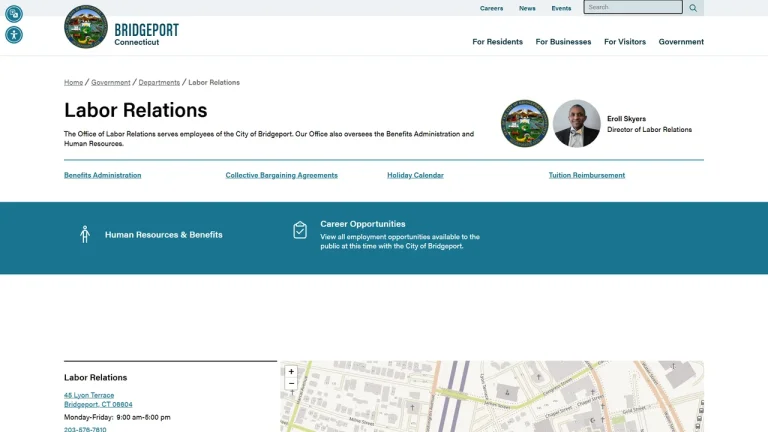
Bridgeport Office of Labor Relations - Bridgeport, CT
City of Bridgeport Office for Persons with Disabilities - Bridgeport, CT
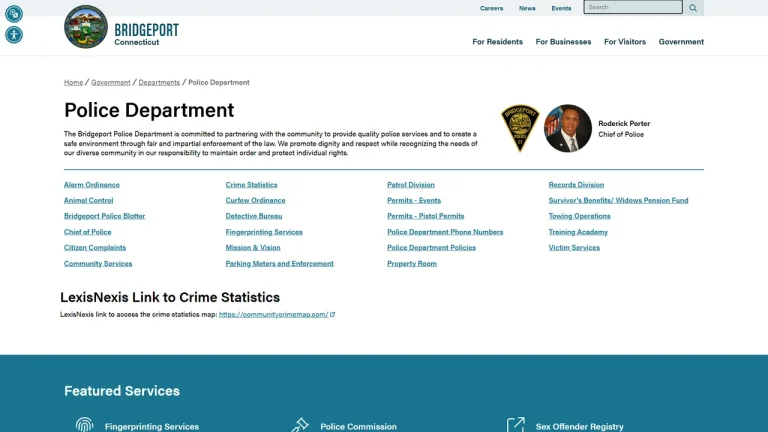

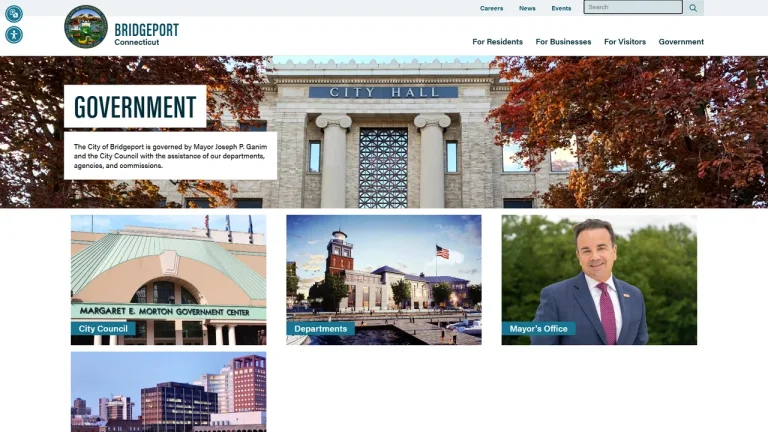
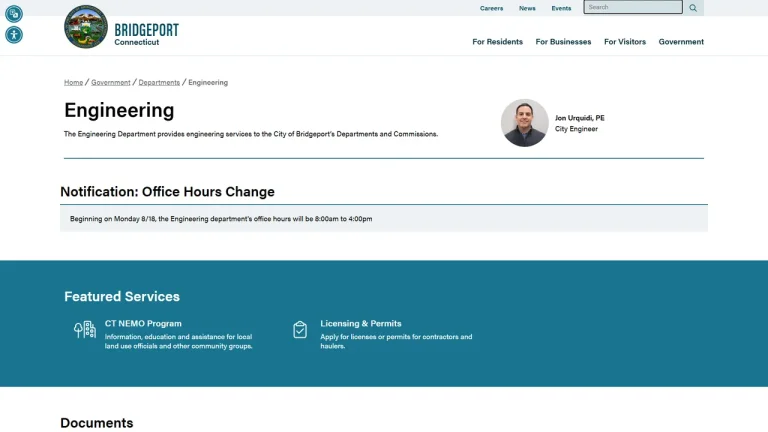
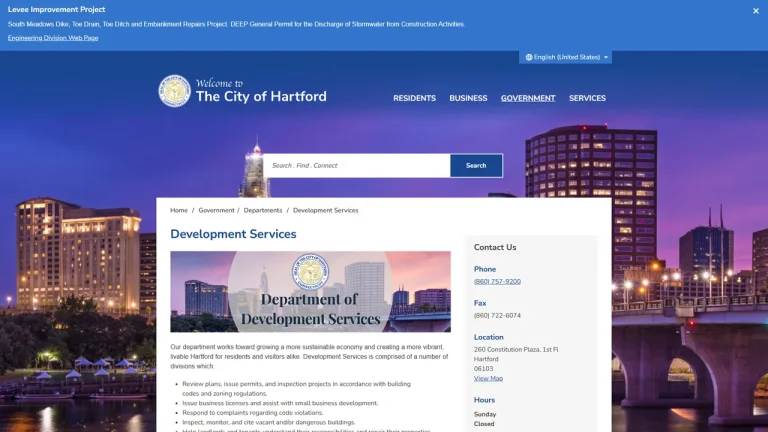
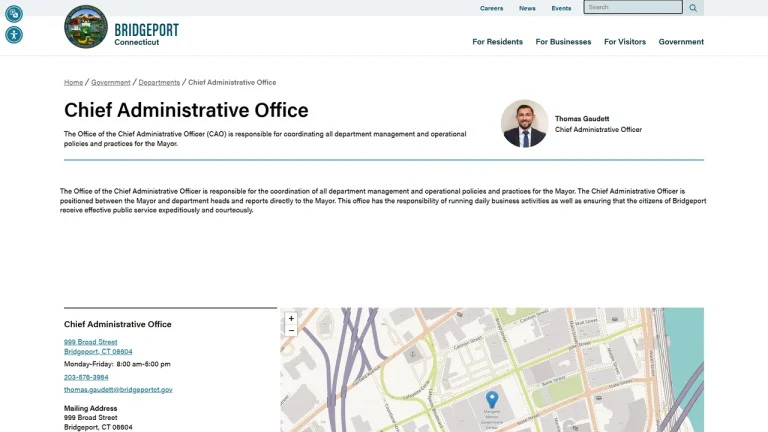

Municipal Governance and Agency Jurisdiction Across Connecticut
Local government in Connecticut functions through a distinctive administrative structure. The Connecticut General Assembly formally abolished county governments in 1960. As a consequence, Connecticut contains no functional county executive boards, county court systems, or county tax authorities. All local municipal powers, municipal ordinances, property recording, and public safety operations are administered directly by the state 169 individual cities and towns.
Within each municipality-such as Bridgeport, New Haven, Stamford, Hartford, Waterbury, Norwalk, Danbury, and Greenwich-the Town or City Clerk serves as the primary registrar of land deeds, local business filings, municipal meeting minutes, and local vital records. Law enforcement and public protection are managed through local municipal police departments or, in smaller rural communities, through the Resident State Trooper program coordinated by the Connecticut State Police. Regional transit and land use planning are coordinated across regional Councils of Governments (COGs).
Local administrative agencies, including Planning and Zoning Commissions, Inland Wetlands and Watercourses Agencies, and local Boards of Assessment Appeals, wield significant regulatory control over real estate and municipal permits. Because each town maintains its own municipal charter and local ordinances, identifying the correct town hall department is essential when filing permit requests, paying municipal taxes, or inspecting public records.
Common Municipal Agency Services, Requirements, and Statutory Fees
| Service / Matter | Required Documents / Prerequisites | Statutory Fee (USD) | Processing Timeline |
|---|---|---|---|
| Land Record Recording (Town Clerk) | Original executed deed or mortgage document, correct legal description, and town conveyance tax form | $60 for first page, $5 each additional page; local transfer taxes apply | Same-day recording at local Town Hall |
| Certified Municipal Vital Record | Valid state photo ID, proof of direct familial relation, and completed local registrar request form | $20 per certified copy (local town rate) | Immediate in person; 5 to 10 days by mail |
| Zoning Board of Appeals (ZBA) Variance | Site survey map, architectural plans, hardship statement, and formal variance application | $150 to $600 depending on municipal fee schedule | 30 to 65 days to scheduled public hearing |
| Municipal Defective Sidewalk Claim Notice | Written notice specifying exact location, time, nature of defect, and injuries sustained | $0 (No filing fee required) | Strict 90-day statutory presentation deadline |
Critical Legal Deadlines & Statutes in Connecticut
Municipal actions in Connecticut are bound by strict statutory deadlines established by the General Assembly. One of the most stringent procedural statutes applies to claims involving defective municipal highways, bridges, or sidewalks. Under Conn. Gen. Stat. § 13a-149, an injured party must provide written notice of injury to the town or city clerk within strictly 90 calendar days of the incident. Missing this 90-day notice requirement completely bars any legal action against the municipality.
When filing tort claims against municipal employees or seeking municipal indemnification, claimants must adhere to the notice mandates set forth under Conn. Gen. Stat. § 7-465. A formal notice of intention to commence an action must be filed with the municipal clerk within 6 months after the cause of action accrued, followed by commencement of the lawsuit within 2 years.
Disputes involving municipal land use determinations carry rapid appeal timelines. Under Conn. Gen. Stat. § 8-8 and Conn. Gen. Stat. § 22a-43, appeals from a municipal Planning and Zoning Commission, Zoning Board of Appeals, or Inland Wetlands Agency must be commenced by serving process within 15 calendar days from the date the municipal notice of decision was published. Additionally, under the Connecticut Freedom of Information Act, municipal bodies must provide access to local public records within 4 business days pursuant to Conn. Gen. Stat. § 1-210 and Conn. Gen. Stat. § 1-212.
Direct Municipal Citizen Interaction vs. Legal Counsel
Residents can handle most routine municipal administrative matters independently. Obtaining certified copies of birth, marriage, or death certificates from the local Town Clerk, applying for standard residential building or mechanical permits, recording residential property deeds, or filing an informal assessment review with the local assessor are straightforward administrative steps handled directly at the local town hall.
However, when a matter involves formal municipal hearings or contested regulatory decisions, retaining an attorney is critical. Navigating land use applications before Planning and Zoning Commissions, seeking variances from local Zoning Boards of Appeals, contesting municipal property tax assessments before the Superior Court under Conn. Gen. Stat. § 12-117a, or pursuing municipal liability claims under Conn. Gen. Stat. § 13a-149 require precise compliance with evidentiary and municipal notice rules. Local counsel familiar with town-specific charters, local boards, and regional superior courts ensures that procedural defects do not compromise property or financial rights.
Red Flags and Consumer Safeguards in Local Government Proceedings
- Third-party private services charging elevated fees to pull municipal property deeds, assess property maps, or obtain marriage certificates that are readily accessible directly from the local Town Clerk for standard statutory fees.
- Unlicensed building expediters or zoning consultants claiming guaranteed variance approvals or special waivers from municipal commissions without formal public hearings.
- Fraudulent texts, emails, or phone notices alleging unpaid municipal parking violations or overdue property taxes that demand payment via gift cards or wire transfers rather than official town tax portals.
- Submitting formal defect notices to the wrong municipal entity or county designation rather than the specific Town Clerk where the incident occurred, which invalidates the claim under Connecticut strict 90-day municipal notice laws.
Frequently Asked Questions
Do county governments exist in Connecticut?
No. Connecticut eliminated county government in 1960. While county boundaries still exist for geographic reference, there are no county-level administrative officials, county courthouses, or county tax authorities. Local governmental authority is exercised entirely by Connecticut 169 distinct towns and cities.
How do I obtain a certified copy of a vital record from a Connecticut town?
Certified copies of birth, marriage, and death records are maintained by the local Town or City Clerk in the municipality where the event occurred or where the parties resided. Requesters must submit a completed application, government photo identification, proof of relationship if applicable, and the statutory fee of $20 per copy.
What is the deadline to file an injury claim against a Connecticut municipality for a sidewalk fall?
Under Conn. Gen. Stat. § 13a-149, a claimant must deliver written notice of the injury, exact location, and time of the occurrence to the Town Clerk within strictly 90 calendar days. Missing this 90-day statutory notice is an absolute bar to recovery in Connecticut courts.
How can I appeal an unfavorable decision made by a local town zoning board?
An appeal of a decision from a Connecticut municipal Zoning Board of Appeals or Planning Commission must be commenced by serving legal process upon the board and town clerk within 15 calendar days from the publication date of the decision, pursuant to Conn. Gen. Stat. § 8-8. The appeal is heard in the Connecticut Superior Court for that judicial district.
Where are real estate deeds and mortgages officially recorded in Connecticut?
All real estate transactions, warranty deeds, mortgages, and land liens are recorded directly in the land records office of the Town Clerk in the specific town where the real property is situated. Connecticut does not maintain a central county registry of deeds.