
Public Records & Filing Offices in Boston
Record real property instruments, access probate archives, and register business certificates in Boston, Massachusetts. The Suffolk County Registry of Deeds, the Boston City Clerk, and the Suffolk Probate Registry maintain official property, commercial, and estate registries under state statutory standards. Consult our verified public records directory below to identify recording fees, submission guidelines, and qualified real estate counsel.
Massachusetts Office of Campaign and Political Finance - Boston, MA


Massachusetts Appeals Court Clerk's Office - Boston, MA






Public Records Administration & Recording Authority in Boston
Public document recording and legal record keeping in Boston are governed through municipal, county, and state statutory repositories. Real property transactions across Boston, Chelsea, Revere, and Winthrop are recorded at the Suffolk County Registry of Deeds, located inside the Edward W. Brooke Courthouse at 24 New Chardon Street in Downtown Boston.
The Suffolk County Registry operates two distinct recordkeeping sections: Recorded Land, which tracks conventional real property instruments, and the Land Court Registered Land Department, which manages indefeasible title certificates issued under the supervision of the Massachusetts Land Court. Instruments recorded include deeds, mortgages, certificates of municipal liens, and mechanics' liens.
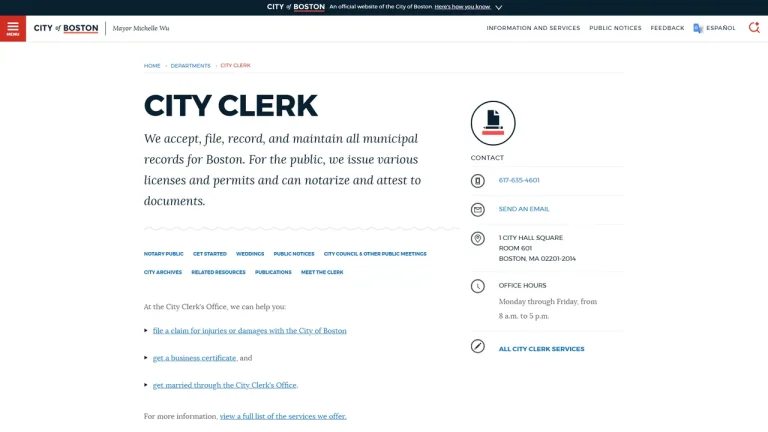
Municipal public records and commercial registrations are administered by the City of Boston City Clerk's Office, situated inside Boston City Hall at One City Hall Square, Room 601. The City Clerk records business certificates for sole proprietorships and partnerships, maintains municipal council proceedings, and archives vital statistics. Testamentary filings and estate dockets are maintained by the Suffolk Probate and Family Court Registry at the Brooke Courthouse, while historic state records are housed at the Massachusetts Archives at Columbia Point.
Boston Public Records Filing & Recording Fee Matrix
| Service / Matter | Required Documents / Prerequisites | Statutory Fee (USD) | Processing Timeline |
|---|---|---|---|
| Real Property Deed Recording (Recorded Land) | Original executed deed, complete property description, Massachusetts deed excise tax payment | $155 statutory base recording fee + deed excise stamps | Same-day via Simplifile e-recording; 2 to 4 business days by mail |
| Land Court Registered Land Conveyance | Original deed, reference to certificate of title number, Land Court approval stamp | $155 statutory Land Court recording fee + excise tax | 3 to 7 business days for document examination |
| Municipal Business Certificate (DBA Registration) | Form BC, notarized signatures of business owners, physical business street address | $65 statutory municipal recording fee | Immediate counter issuance; valid for four calendar years |
| Probate Estate Opening & Will Recording | Original will, certified death certificate, formal petition (Form MPC 101), surcharges | $375 base probate entry fee + $15 surcharge | Letters of Authority issued within 10 to 20 business days |
Critical Legal Deadlines & Statutes in Massachusetts Records Filings
Conveyancing standards, recording priority, and public record filings in Boston are governed by the Massachusetts General Laws. Under Mass. Gen. Laws ch. 183, § 4, Massachusetts functions as a race-notice recording jurisdiction, establishing that unrecorded conveyances, mortgages, or long-term leases are invalid against third parties without actual notice, making prompt recording at 24 New Chardon Street critical to secure title.
Transfers of real property are subject to the Massachusetts deeds excise tax pursuant to Mass. Gen. Laws ch. 64D, § 1, which imposes a mandatory state tax rate of $4.56 per $1,000 of consideration across Suffolk County. In addition, sole proprietors and partnerships operating under an assumed name must file a business certificate with the Boston City Clerk under Mass. Gen. Laws ch. 110, § 5 prior to commencing business, with renewals mandated every four years.
Estate administration filings handled by the Suffolk Probate Court are strictly limited by the Massachusetts Uniform Probate Code under Mass. Gen. Laws ch. 190B, § 3-803, which establishes an absolute one-year statute of limitations from the date of the decedent's death for creditors to present claims against an estate. Contractors recording mechanics' liens against property in Boston must record a notice of contract within statutory time limits under Mass. Gen. Laws ch. 254, § 2 to preserve statutory lien rights.
Direct Record Access vs. Real Estate & Probate Legal Counsel
Individuals can manage standard public record searches and routine filing tasks directly. Searching recorded instruments on the statewide Masslandrecords database, renewing a four-year business certificate at Boston City Hall, or purchasing certified copies of recorded deeds at the Brooke Courthouse are standard public transactions that do not require legal counsel.
However, retaining an experienced Massachusetts real estate lawyer or probate practitioner is critical when dealing with complex property transactions. Navigating the requirements of the Land Court Registered Land division, drafting deeds involving life estates or commercial rights-of-way, clearing encumbrances from prior mortgages, or defending mechanics' liens under Chapter 254 require professional legal assistance. Errors in title conveyances can result in unmarketable title, leading to costly land court petition proceedings.
Red Flags & Property Record Warnings in Boston
- Misleading solicitations sent to new property owners charging $80 to $100 for a copy of a deed that can be obtained from the registry for a nominal copy fee.
- Failing to record a deed immediately in Suffolk County, creating risk under the state race-notice recording statute in Massachusetts General Laws Chapter 183.
- Failing to distinguish between Recorded Land and Registered Land at the Suffolk Registry of Deeds, resulting in immediate rejection of conveyancing instruments.
- Missing the strict one-year statute of limitations under the Massachusetts Uniform Probate Code for asserting creditor claims against a decedent's estate.
Frequently Asked Questions
Where is the Suffolk County Registry of Deeds located?
The Suffolk County Registry of Deeds is located inside the Edward W. Brooke Courthouse at 24 New Chardon Street in Downtown Boston, serving Boston, Chelsea, Revere, and Winthrop.
What is the difference between Recorded Land and Registered Land in Boston?
Recorded Land constitutes standard registry recording, while Registered Land operates under the jurisdiction of the Massachusetts Land Court, where title is court-guaranteed and indexed by certificate number.
How do I file a DBA business certificate in Boston?
A business certificate (DBA) must be filed with the Boston City Clerk at Boston City Hall, One City Hall Square, Room 601. The filing requires notarized signatures and remains valid for four years.
What is the Massachusetts deeds excise tax rate in Suffolk County?
Under Massachusetts General Laws Chapter 64D, § 1, the deeds excise tax in Suffolk County is $4.56 per $1,000 of the total purchase consideration stated on the deed.
Can I search Suffolk County property deeds and title records online?
Yes. Recorded land documents and Land Court certificates can be searched online via the statewide Masslandrecords public access portal maintained by the Secretary of the Commonwealth.