
Government Agencies in New Hampshire
Interacting with New Hampshire state agencies requires an understanding of Commonwealth administrative rules, executive departments, and Concord-based regulatory boards. From corporate formations and environmental permitting to professional licensing and public health, state agencies govern civil and commercial activity across the state. Explore our comprehensive statewide directory below to connect directly with department commissioners, regional directors, and administrative filing offices.

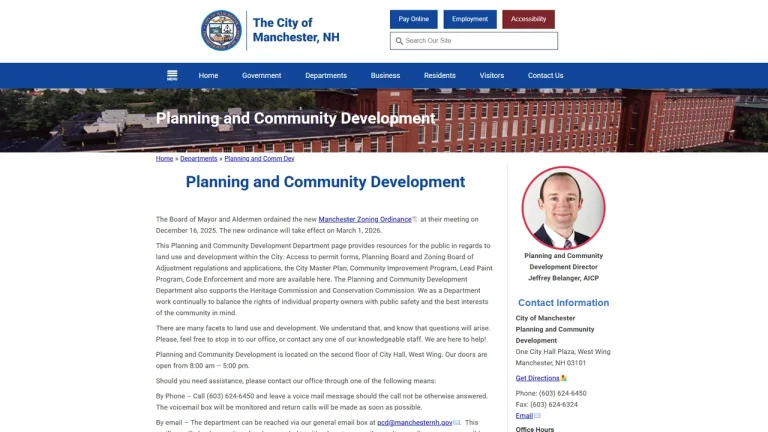
Manchester Planning Department - Manchester, NH








The Administrative Structure of New Hampshire State Government
Executive power in the State of New Hampshire is administered through a distinctive constitutional framework centered at the New Hampshire State House in Concord, Merrimack County. Unlike most states, New Hampshire's executive authority is shared between the Governor and a constitutional five-member Executive Council. The Governor and Executive Council oversee state administration, approve major state contracts, confirm judicial and agency appointments, and direct appropriations for major departments serving communities from Manchester and Nashua to Portsmouth and the North Country.
State administration is carried out through specialized executive agencies and commissions. The Department of Health and Human Services (DHHS), headquartered in Concord, manages public assistance, Medicaid, and child protection services through the Division for Children, Youth and Families (DCYF). Commercial entity formations, trademark registrations, and state election oversight are administered by the Department of State under the Secretary of State, while corporate tax compliance is managed by the Department of Revenue Administration (NHDRA), which oversees the Business Profits Tax and Business Enterprise Tax.
Environmental protections, water rights, and development permits are enforced by the Department of Environmental Services (NHDES), and professional licensing across dozens of trades and medical fields is centralized under the Office of Professional Licensure and Certification (OPLC). Understanding the regulatory authority and procedural rules of these agencies is essential for securing business credentials, petitioning for administrative hearings, or appealing regulatory enforcement actions.
Core State Agency Services & Statutory Fee Schedules
| Service / Matter | Required Documents / Prerequisites | Statutory Fee (USD) | Processing Timeline |
|---|---|---|---|
| Professional License Application (OPLC) | Application Form, Official Transcripts, Board Exam Results, Background Check | $100 - $350 (Varies by board) | 3 to 6 weeks |
| Right-to-Know Public Records Request | Written RSA 91-A Request, Specific Record Scope, Contact Details | Free (Actual reproduction costs) | Strictly within 5 business days |
| Domestic LLC Certificate of Formation Filing | Form LLC-1, Registered Agent Designation, Member Signature | $100 Statutory Base Fee | 5 to 10 business days (Expedite: 24 hrs) |
| Department of Labor Wage Claim Filing | Completed Wage Claim Form, Pay Stubs, Written Employment Contract | Free (Statutory Public Service) | 30 to 60 days to hearing |
Critical Legal Deadlines & Statutes in New Hampshire
Engaging with New Hampshire state agencies requires strict adherence to statutory timelines established under state administrative codes. The universal framework for agency rulemaking and contested hearings is the New Hampshire Administrative Procedure Act, codified at N.H. Rev. Stat. Ann. § 541-A:1. When an agency issues an adverse final order in an adjudicatory proceeding, a party must file a motion for rehearing with the agency within strictly 30 days under N.H. Rev. Stat. Ann. § 541:3 before any judicial review can be sought.
If the agency denies the motion for rehearing, an appeal must be filed with the New Hampshire Supreme Court within 30 days of the denial notice pursuant to N.H. Rev. Stat. Ann. § 541:6. Failure to adhere to this two-step administrative appeal process permanently bars judicial review.
Public access to state government records is governed by New Hampshire's Right-to-Know Law under N.H. Rev. Stat. Ann. § 91-A:4. The agency must provide the record, issue a written denial, or provide a written estimate of the time needed to satisfy the request within 5 business days of receiving the petition. In civil rights disputes, complaints alleging unlawful employment or housing discrimination must be filed with the New Hampshire Commission for Human Rights pursuant to N.H. Rev. Stat. Ann. § 354-A:21 within 2 years of the alleged discriminatory act.
Direct Citizen Interaction vs. Retaining Legal Counsel
Citizens and business owners frequently conduct standard administrative transactions directly with New Hampshire state agencies. Filing annual business reports with the Secretary of State, applying for food or medical benefits through the DHHS NH EASY online portal, submitting an RSA 91-A public records inquiry, or filing a wage claim with the Department of Labor can be managed independently without retaining counsel.
However, when administrative proceedings involve disciplinary action, environmental sanctions, or formal evidentiary hearings, legal representation is indispensable. Contested cases before OPLC licensing boards, wetlands violation citations issued by NHDES, or corporate tax disputes with NHDRA before the Board of Tax and Land Appeals involve formal rules of evidence, examination of expert witnesses, and administrative briefs. The record compiled during these agency proceedings forms the exclusive evidentiary foundation for any subsequent appeal.
Furthermore, small claims divisions in the New Hampshire Circuit Court under N.H. Rev. Stat. Ann. § 503:1 have a $10,000 ceiling and lack jurisdiction to issue injunctive orders against state agencies or reverse administrative sanctions. An experienced administrative law attorney ensures that constitutional due process claims are preserved and statutory rehearing deadlines under RSA 541 are timely satisfied.
Red Flags & Public Safety Warnings Regarding State Agencies
- Beware of misleading direct-mail solicitations sent by private organizations charging $125 to $175 for filing a corporate Certificate of Status or annual report that can be submitted directly to the Secretary of State for the statutory $100 fee.
- Never miss the strict 30-day deadline to file a motion for rehearing under N.H. Rev. Stat. Ann. § 541:3 following an agency decision, as failing to do so forfeits your right to appeal to the New Hampshire Supreme Court.
- Reject unaccredited consultants or expeditors who claim private connections or guaranteed outcomes before the Governor, Executive Council, or OPLC licensing boards.
- Avoid non-governmental websites that mimic official state portals to harvest sensitive identity documents or assess extra fees for standard state licensing applications.
Frequently Asked Questions
How do I appeal an adverse decision made by a New Hampshire state agency?
Under N.H. Rev. Stat. Ann. § 541:3, you must first file a formal motion for rehearing with the agency within 30 days of the decision. If the motion is denied, you have 30 days to appeal to the New Hampshire Supreme Court under N.H. Rev. Stat. Ann. § 541:6.
What is the response timeline under New Hampshire's Right-to-Know Law?
Pursuant to N.H. Rev. Stat. Ann. § 91-A:4, a public agency must make records available, provide a written denial, or furnish a written explanation of the delay within five business days of receiving the request.
What is the role of the New Hampshire Executive Council?
The Executive Council is a constitutional five-member elected body that shares executive authority with the Governor, voting on state contracts exceeding $10,000, judicial appointments, and departmental commissioner nominations.
What agency oversees business formation and commercial licensing in New Hampshire?
Business formations (such as LLCs and corporations) are filed with the Department of State, Corporate Division, in Concord, while individual trade and occupational certifications are regulated by the Office of Professional Licensure and Certification (OPLC).
Where can I file a wage claim against an employer in New Hampshire?
Wage claims for unpaid compensation or unauthorized payroll deductions are filed with the New Hampshire Department of Labor in Concord, which investigates claims and conducts administrative wage hearings.