
Courts in New Jersey
New Jersey courts resolve civil claims, criminal cases, family disputes, and municipal citations through a unified judiciary organized across fifteen vicinages. Citizens and attorneys can search dockets via eCourts, file pleadings, and track proceedings from municipal courthouses to the Supreme Court in Trenton. Explore our directory below to locate New Jersey courthouses, clerk contacts, and division filing guidelines.






Chambers of Honorable Verna G Leath - Superior Court Judge - Newark, NJ





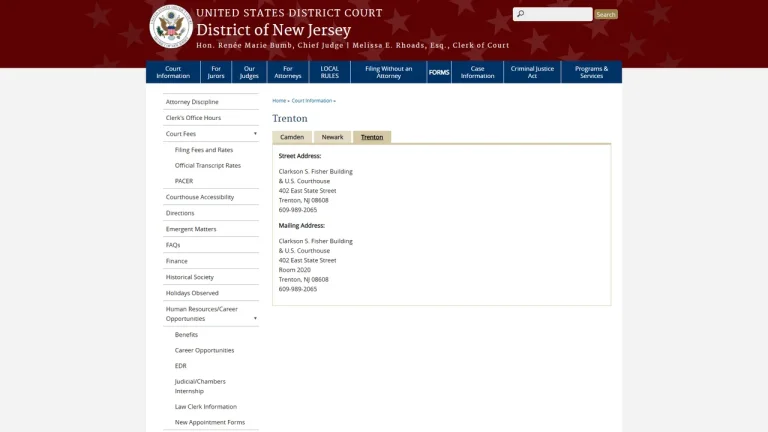
Clarkson S. Fisher Federal Building And United States Courthouse - Trenton, NJ

New Jersey Judicial Framework & Court Vicinages
The State of New Jersey operates a nationally recognized unified judicial system established under Article VI of the New Jersey Constitution. The Supreme Court of New Jersey, seated at the Richard J. Hughes Justice Complex in the state capital of Trenton, serves as the court of last resort, possessing final appellate authority and administrative supervisory jurisdiction over all state courts. Intermediate appellate review is conducted statewide by the Superior Court of New Jersey, Appellate Division.
Trial jurisdiction is exercised primarily through the Superior Court of New Jersey, organized geographically into 15 judicial vicinages serving all 21 counties, including high-volume vicinages in Essex, Bergen, Hudson, Middlesex, Monmouth, and Camden counties. The Superior Court is divided into functional divisions: the Law Division (encompassing the Criminal Part for indictable offenses and the Civil Part), the Chancery Division (encompassing General Equity and the Family Part for matrimonial and juvenile matters), and the Special Civil Part.
At the local level, over 500 Municipal Courts exercise limited jurisdiction over motor vehicle moving violations under Title 39, municipal ordinance infractions, and non-indictable disorderly persons offenses. Additionally, the Tax Court of New Jersey provides specialized statewide review of local real property assessments and state tax determinations. Electronic document filing and docket searches are managed through the statewide eCourts online portal.
Key New Jersey Court Filings, Requirements & Deadlines
| Service / Matter | Required Documents / Prerequisites | Statutory Fee (USD) | Processing Timeline |
|---|---|---|---|
| Superior Court Law Division Civil Complaint | Civil Case Information Statement (CIS), verified complaint, summons, and electronic filing via eCourts | $250 statutory civil filing fee | 35 days for defendant answer under New Jersey Court Rule 4:6-1 |
| Special Civil Part Small Claims Action | Completed Small Claims Complaint, defendant contact info, statement of claim, and service fee | $35 base filing fee plus $7 for each additional defendant | Hearing scheduled within 30 to 45 days (N.J. Ct. R. 6:1-2) |
| Notice of Claim Under NJ Tort Claims Act | Formal written notice specifying injury details, public entity involved, and certified service | $0 statutory notice fee | Mandatory notice within 90 days (N.J. Stat. Ann. § 59:8-8) |
| Notice of Appeal to the Appellate Division | Notice of Appeal, Case Information Statement, transcript request, and proof of service | $250 appellate filing fee | Strictly within 45 days of final judgment entry (N.J. Ct. R. 2:4-1) |
Critical Legal Deadlines & Statutes in New Jersey
Litigants participating in New Jersey judicial proceedings must observe strict statutory limitation periods and court rules:
- Small Claims Statutory Limit: Under New Jersey Court Rule 6:1-2(a)(2), the Small Claims Section of the Special Civil Part holds jurisdiction over contract and tort actions where the amount in controversy does not exceed $5,000, as well as security deposit disputes up to $5,000.
- New Jersey Tort Claims Act Notice Window: Under N.J. Stat. Ann. § 59:8-8, a claimant seeking damages against a New Jersey state, county, or municipal entity must file a formal written Notice of Claim within 90 days after accrual of the cause of action. Failure to meet this 90-day deadline forever bars recovery.
- Personal Injury Statute of Limitations: General actions for personal injury or wrongful death must be commenced within 2 years from the date of injury under N.J. Stat. Ann. § 2A:14-2.
- Contract Action Limitations: Civil actions founded on recovery upon a contractual obligation or liability must be initiated within 6 years under N.J. Stat. Ann. § 2A:14-1.
- Appellate Deadlines: Under New Jersey Court Rule 2:4-1, an appeal to the Appellate Division must be taken within 45 days from the date of entry of final judgment.
Direct Agency Access vs. Legal Counsel
The New Jersey Judiciary provides robust self-help programs and Ombudsman offices across all 15 vicinages to assist self-represented litigants (pro se). Individuals can effectively represent themselves in the Small Claims Section of the Special Civil Part for money damages up to $5,000 under New Jersey Court Rule 6:1-2. In small claims cases-such as unreturned security deposits, consumer debt disputes, or minor property damage-proceedings are streamlined, and judges or law clerks facilitate settlement without complex evidentiary disputes. Litigants also frequently handle routine traffic tickets pro se in local Municipal Courts.
However, once a civil claim exceeds $5,000 or enters the regular Special Civil Part ($5,000 to $20,000) or the Law Division Civil Part (exceeding $20,000), retaining an attorney is essential. The New Jersey Court Rules impose strict procedural requirements, including the mandatory exchange of Form Interrogatories, document demands under Rule 4:18, deposition practice, and motions for summary judgment under Rule 4:46. Crucially, under New Jersey Court Rule 1:21-1(c), business entities-including corporations, partnerships, and limited liability companies-are prohibited from appearing pro se in any state court except small claims, and must be represented by an attorney admitted to the New Jersey Bar.
When handling indictable offenses in the Criminal Part, contested divorces in the Family Part, or appeals before the Appellate Division, legal representation is indispensable to avoid dismissal or procedural default.
Common Red Flags & Regulatory Pitfalls
- Missing the 90-Day Tort Claims Window: Failing to serve a written Notice of Claim on a New Jersey governmental body within 90 days under N.J. Stat. Ann. § 59:8-8, which results in permanent dismissal of personal injury or property damage claims.
- Corporate Pro Se Violations: Attempting to file or defend a lawsuit on behalf of an LLC or corporation without licensed legal counsel in violation of New Jersey Court Rule 1:21-1(c), resulting in immediate dismissal of pleadings.
- Jury Duty Phone Impersonation Scams: Fraudsters posing as sheriff's officers or court clerks demanding payment over the phone for missed jury duty; New Jersey courts never request payment or personal financial details via telephone.
- Ignoring Municipal Court Summonses: Failing to appear in Municipal Court for traffic or disorderly persons matters, resulting in an automatic bench warrant and driver's license suspension reported to the New Jersey Motor Vehicle Commission.
Frequently Asked Questions
What is the monetary jurisdictional limit for small claims court in New Jersey?
Under New Jersey Court Rule 6:1-2(a)(2), the Small Claims Section of the Special Civil Part hears contract and tort disputes up to $5,000, including landlord-tenant security deposit returns up to $5,000.
What is a court vicinage in New Jersey?
A vicinage is a regional judicial district in New Jersey. The state's 21 counties are organized into 15 vicinages, each managed by an Assignment Judge and Trial Court Administrator.
How long do I have to file a claim against a New Jersey public entity?
Under the New Jersey Tort Claims Act (N.J. Stat. Ann. § 59:8-8), a formal written Notice of Claim must be served on the responsible public body within 90 days of the injury or property damage.
Can a business entity represent itself in New Jersey courts?
Under New Jersey Court Rule 1:21-1(c), business entities including LLCs and corporations must be represented by an attorney admitted to practice in New Jersey for all matters outside small claims.
What is the deadline to appeal a final judgment to the New Jersey Appellate Division?
Pursuant to New Jersey Court Rule 2:4-1, a Notice of Appeal must be filed with the Appellate Division within 45 days of the entry of a final order or judgment in the trial court.