
Federal Law Enforcement in Philadelphia
Federal law enforcement agencies in Philadelphia investigate statutory violations across the Eastern District of Pennsylvania, safeguarding regional integrity and constitutional rights. Operating from landmark facilities in Center City, federal bureaus handle complex white-collar, organized crime, and national security matters. Consult our directory below to locate federal field offices, submit regulatory reports, and access authorized contact details.
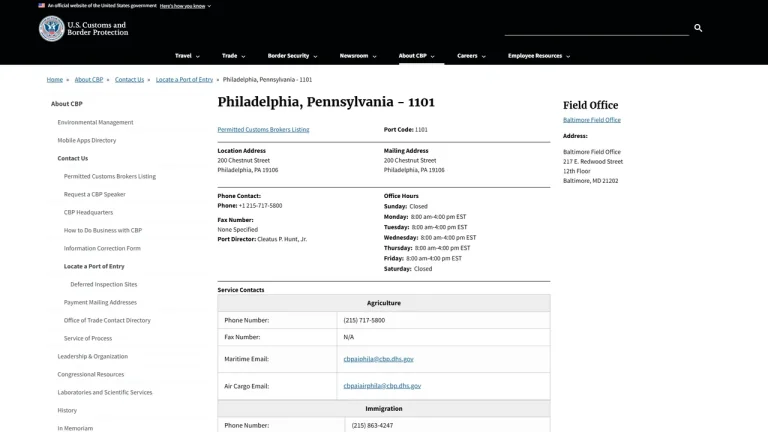
U.S. Customs and Border Protection - Philadelphia Service Port - Philadelphia, PA

US Department of Justice - U.S. Attorney's Office - Philadelphia, PA


U.S. Department of State - Diplomatic Security Service - Philadelphia, PA
US Small Business Administration - Office of Inspector General - Philadelphia, PA
Federal Law Enforcement Operations in the Eastern District of Pennsylvania
Philadelphia serves as the administrative and judicial center for federal law enforcement within the United States District Court for the Eastern District of Pennsylvania (EDPA). The cluster of federal agencies based in Center City exercises broad jurisdiction over matters crossing state borders, national security investigations, public corruption, major narcotics trafficking networks, and complex corporate fraud occurring throughout the region.
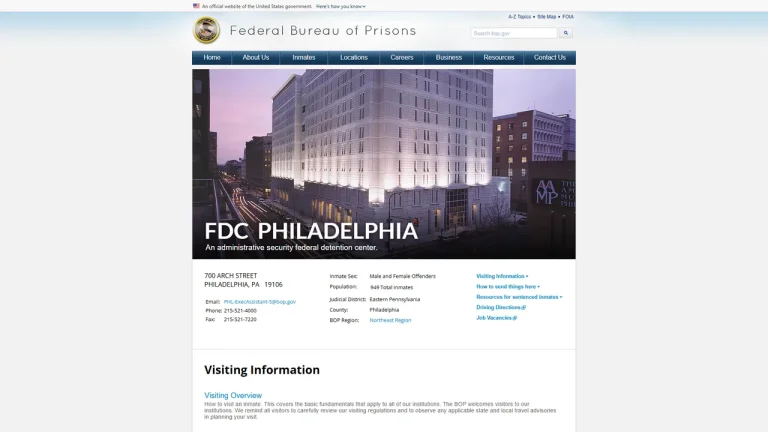
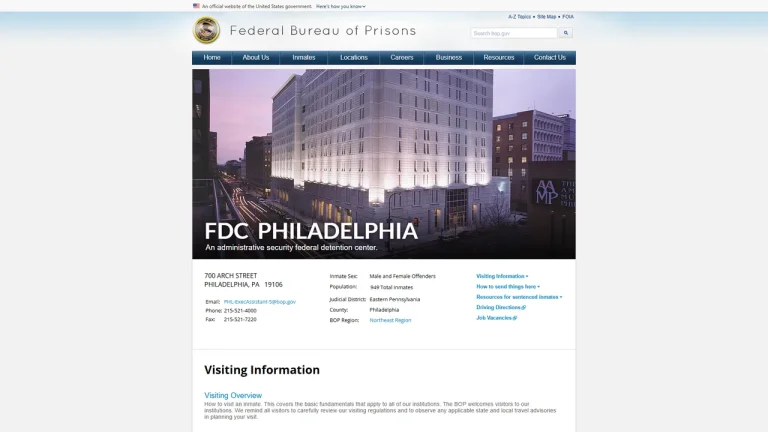
Key agencies are concentrated around Independence Mall. The Federal Bureau of Investigation (FBI) Philadelphia Field Office and the Drug Enforcement Administration (DEA) Philadelphia Field Division operate out of the William J. Green, Jr. Federal Building at 600 Arch Street. The Bureau of Alcohol, Tobacco, Firearms and Explosives (ATF) maintains offices at the U.S. Custom House on Chestnut Street, while the United States Marshals Service manages federal fugitive apprehension and courthouse security out of the James A. Byrne U.S. Courthouse at 601 Market Street. Federal pretrial detainees and post-indictment defendants are housed at the Federal Detention Center (FDC Philadelphia) at 700 Arch Street.
Federal Agency Procedures and Regulatory Filing Schedules
| Service / Matter | Required Documents / Prerequisites | Statutory Fee (USD) | Processing Timeline |
|---|---|---|---|
| Federal Agency FOIA Request | Form DOJ-361 certification of identity, specific record description | $0.00 standard ($0.10/page after 100 pages) | 20 business days to several months |
| Civil Asset Forfeiture Claim | Verified claim of property interest under oath, identifying case number | $0.00 statutory fee | 30 to 35 days from direct notice |
| Federal Grand Jury Subpoena Response | Responsive electronic records, certified business records affidavit | $0.00 (production costs borne by target) | Specified by return date on subpoena |
| Attorney Legal Visit (FDC Philadelphia) | Active EDPA bar credentials, government photo ID, security clearance | $0.00 access fee | 24-hour advance electronic scheduling |
Federal Statutory Deadlines and Criminal Procedure Rules
Federal law enforcement operations and prosecutions are anchored in the statutory provisions of Title 18 of the United States Code. Agencies investigate criminal enterprises under statutory offenses such as wire fraud under 18 U.S. Code § 1343, mail fraud under 18 U.S. Code § 1341, and racketeering enterprises under 18 U.S. Code § 1962.
Statutory timelines in federal proceedings are uncompromising. Under 18 U.S. Code § 3282, the default general statute of limitations for non-capital federal crimes is five years, although financial institution fraud extends to ten years pursuant to 18 U.S. Code § 3293. Once an individual is taken into custody by federal authorities, the federal Speedy Trial Act codified at 18 U.S. Code § 3161 dictates that an indictment must be filed within thirty days of arrest, and trial must commence within seventy days from the filing date of the information or indictment. Moreover, asserting ownership over seized currency or property during federal forfeiture proceedings requires filing a formal claim under 18 U.S. Code § 983 within thirty to thirty-five days of statutory notice.
Direct Citizen Reporting vs. Retaining Federal Criminal Defense Counsel
Citizens can interface directly with federal law enforcement agencies for basic reporting tasks. Submitting public crime tips to the FBI, reporting illicit drug distribution locations to the DEA, or transmitting Freedom of Information Act (FOIA) requests through agency portals can be executed directly without formal legal representation.
However, if an individual or corporate executive is approached by federal special agents for a voluntary interview, served with a federal grand jury subpoena, or receives a formal target letter from the U.S. Attorney's Office for the Eastern District of Pennsylvania, retaining an attorney admitted to practice in the EDPA is an urgent necessity. Making false or misleading statements to a federal investigator constitutes an independent federal felony under 18 U.S. Code § 1001. An experienced federal criminal defense lawyer manages all agent communications, conducts proffer negotiations, and prepares trial defenses under the Federal Rules of Criminal Procedure.
Federal Impersonation Schemes and Procedural Pitfalls
- Be vigilant against telephone scams where callers spoof official federal numbers from the FBI, DEA, or US Marshals Service demanding immediate digital currency payments to resolve fabricated federal arrest warrants.
- Never agree to informal, unrecorded conversations with federal special agents without experienced federal defense counsel present to protect your rights against unintentional self-incrimination.
- Do not ignore federal grand jury subpoenas for corporate records or personal documents, as non-compliance can trigger civil and criminal contempt proceedings in federal court.
- Beware of non-specialized legal practitioners attempting to handle federal matters; federal court practice requires deep familiarity with the United States Sentencing Guidelines and local EDPA rules.
Frequently Asked Questions
Where is the FBI Philadelphia Field Office located?
The FBI Philadelphia Field Office is located within the William J. Green, Jr. Federal Building at 600 Arch Street, 8th Floor, Philadelphia, PA 19106, adjacent to the historic Center City district.
What should I do if federal special agents knock on my door?
Ask to inspect their official credentials, request their business cards, and politely assert your constitutional right to remain silent and consult with an attorney before answering any questions or consenting to a warrantless search.
What is the difference between a target, subject, and witness in a federal probe?
A witness is a person with factual knowledge but no exposure; a subject is an individual whose conduct is within the scope of the federal investigation; and a target is an individual whom the federal prosecutor has substantial evidence linking to a crime, with indictment imminent.
Where are federal defendants detained prior to trial in Philadelphia?
Pretrial federal defendants facing prosecution in the Eastern District of Pennsylvania are primarily housed at the Federal Detention Center (FDC Philadelphia), an administrative security facility located at 700 Arch Street.
What core responsibilities are handled by the U.S. Marshals Service in Philadelphia?
The U.S. Marshals Service manages security for federal judicial officers, courthouse personnel, and witnesses at the James A. Byrne U.S. Courthouse, coordinates federal prisoner custody and transport, and executes federal fugitive warrants.