
Federal Law Enforcement in New Jersey
Federal law enforcement agencies in New Jersey operate under the jurisdiction of the United States District Court to investigate and prosecute federal crimes. While standard Freedom of Information Act inquiries, regulatory tip submissions, and federal clearance requests proceed through administrative desks, grand jury subpoenas and target letters require aggressive legal intervention. Browse our verified statewide directory below to connect with regional headquarters, field divisions, and investigative task forces across New Jersey.

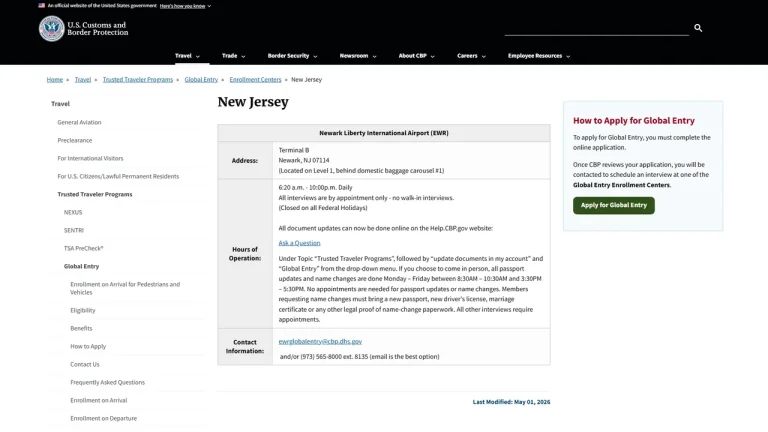
CBP Newark Liberty International Airport - Newark, NJ

National Guard Recruiting Station - Jersey City Armory - Jersey City, NJ


Civil Air Patrol - Jersey City Composite Squadron - Jersey City, NJ

Bureau of Alcohol, Tobacco, Firearms and Explosives - Trenton Field Office – Trenton, NJ

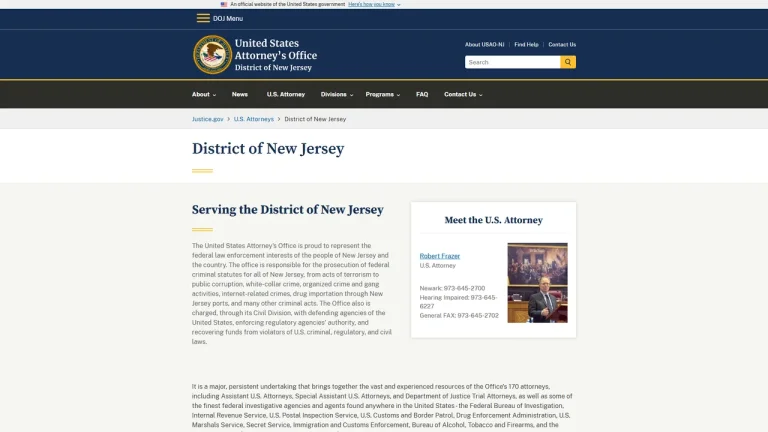
United States Attorney's Office - District of New Jersey - Newark, NJ

The Federal Law Enforcement Framework in New Jersey
Federal law enforcement operations across the State of New Jersey function under the prosecutorial direction of the United States Attorney's Office for the District of New Jersey. As a single federal judicial district, the District of New Jersey is anchored by main executive headquarters in the Peter W. Rodino Federal Building in Newark, with operational branch offices located in the Clarkson S. Fisher Federal Building in Trenton and the Mitchell H. Cohen Building and U.S. Courthouse in Camden.
Federal investigative authority is executed through primary regional field divisions. These include the Federal Bureau of Investigation (FBI) Newark Field Office, the Drug Enforcement Administration (DEA) New Jersey Division in Newark, Homeland Security Investigations (HSI) Newark, the Bureau of Alcohol, Tobacco, Firearms and Explosives (ATF) Newark Field Division, the Internal Revenue Service Criminal Investigation (IRS-CI), and the United States Marshals Service for the District of New Jersey.
Federal enforcement focuses heavily on critical infrastructure and interstate commerce networks throughout the state, including the Port of New York and New Jersey, Newark Liberty International Airport, financial corridors in Jersey City, and major maritime shipping lanes. Federal task forces coordinate joint investigations with county prosecutors and the New Jersey State Police to address complex white-collar crimes, international narcotics trafficking, federal firearms offenses, public corruption, and corporate fraud.
Common Federal Agency Inquiries & Processing Standards
| Service / Matter | Required Documents / Prerequisites | Statutory Fee (USD) | Processing Timeline |
|---|---|---|---|
| Federal FOIA Records Request | Written request, detailed agency record description, requester category | $0 base fee; duplication/search fees apply | 20 business days statutory determination |
| Federal Tort Claims Act Notice (SF-95) | Executed Form SF-95, verified damages calculation, sum certain | $0 statutory administrative fee | 6 months mandatory agency review |
| Federal Grand Jury Subpoena Response | Subpoena duces tecum, formal document index, appearance entry | $0 court fee | Return date specified on subpoena |
| Federal Security Clearance Processing | Standard Form 86 (SF-86), electronic fingerprints via e-QIP, background release | $0 applicant fee for agency clearance | 60 to 180 calendar days |
Critical Legal Deadlines & Statutes in New Jersey
Engaging with federal investigative bodies involves compliance with federal statutory timetables and court rules. Under the Freedom of Information Act, 5 U.S. Code § 552, a federal law enforcement agency must issue a formal determination regarding an official records request within 20 business days. For administrative tort claims arising from injuries or property damage caused by federal officers, 28 U.S. Code § 2401 dictates that Standard Form 95 must be presented to the appropriate agency within 2 years of accrual.
In criminal proceedings, the general statute of limitations for non-capital federal crimes is 5 years under 18 U.S. Code § 3282, though offenses such as major securities fraud, bank fraud, and certain cybercrimes feature extended limitation periods. Following a formal federal arrest, the Speedy Trial Act under 18 U.S. Code § 3161 mandates that an indictment must be filed within 30 days of the arrest, and trial must commence within 70 days of the indictment or initial appearance, subject to statutory excludable delays. Motions to quash federal subpoenas must be filed before the return date pursuant to Federal Rule of Criminal Procedure 17(c).
Direct Agency Interaction vs. Federal Criminal Defense Counsel
Certain interactions with federal law enforcement agencies can proceed without retaining legal counsel. Private individuals and corporate compliance officers can submit general FOIA inquiries, report suspected financial frauds or tips via online agency portals, apply for federal security clearances, or access public regulatory databases directly through federal self-service mechanisms.
However, when an individual or business receives a Target Letter, Subject Letter, or federal grand jury subpoena from the U.S. Attorney's Office in Newark, retaining an attorney admitted to the Bar of the United States District Court for the District of New Jersey is critical. Federal agents are skilled interrogators, and voluntary statements can lead to felony charges for making false statements under 18 U.S. Code § 1001. Federal criminal defense counsel is vital for evaluating search warrants, structuring formal proffer agreements, negotiating with Assistant United States Attorneys (AUSAs), and defending clients in the federal courthouses in Newark, Trenton, or Camden.
Red Flags & Federal Enforcement Warnings
- Informal Interview Pitfalls: Never agree to speak with federal agents (such as FBI or DEA) during an unannounced visit to your home or office without legal counsel present; any factual inaccuracy can be prosecuted under 18 U.S.C. § 1001.
- Federal Impersonation Wire Scams: Scammers frequently pose as federal marshals or DEA agents in Newark, demanding Bitcoin or gift card transfers to clear bogus warrants; federal authorities will never solicit funds by phone to settle criminal matters.
- Omission of the Sum Certain on FTCA Forms: Submitting Standard Form 95 without stating an exact, definite dollar figure (sum certain) creates an incurable jurisdictional flaw that permanently invalidates subsequent federal court actions.
- Spoliation After Subpoena Issuance: Altering, deleting, or failing to preserve digital records, emails, or text messages after receiving a federal subpoena or preservation letter triggers immediate obstruction of justice charges under 18 U.S.C. § 1519.
Frequently Asked Questions
Where is the United States Attorney's Office located in New Jersey?
The main headquarters of the U.S. Attorney's Office for the District of New Jersey is located in the Peter W. Rodino Federal Building at 970 Broad Street in Newark. The office also operates staffed branch offices in Trenton at the Clarkson S. Fisher Federal Building and in Camden at the Mitchell H. Cohen Courthouse.
What is the difference between a target, subject, and witness in a federal investigation?
In a federal investigation, a target is a person whom the prosecutor has substantial evidence linking to a crime; a subject is someone whose conduct falls within the scope of the grand jury's investigation; and a witness is an individual with relevant factual information who is not personally under suspicion.
What should I do if federal agents arrive with a search warrant at my New Jersey business?
Request to examine the search warrant and affidavit to verify the signed judicial authorization and scope of property to be seized. Immediately contact a federal criminal defense attorney, do not obstruct the agents, and instruct employees to refrain from answering substantive investigative questions without counsel.
Which federal court hears criminal prosecutions in New Jersey?
All federal criminal charges and civil litigation in the state are adjudicated by the United States District Court for the District of New Jersey, which holds court sessions in three vicinages: Newark (Northern), Trenton (Central), and Camden (Southern).
How long do federal prosecutors have to file charges in New Jersey?
Under 18 U.S.C. § 3282, the general federal statute of limitations is 5 years for most non-capital federal crimes. However, specific federal violations-including capital offenses, certain financial crimes, and racketeering conspiracies-carry significantly longer or indefinite limitation periods.