
Courts in New York
Explore the New York State Unified Court System directory to locate trial, appellate, and specialty courts, access electronic dockets, and view filing rules. Courthouses across all judicial districts maintain open public calendars and electronic case filing through NYSCEF. Review our verified directory below to find court clerk locations, operating schedules, and jurisdictional resources across New York.

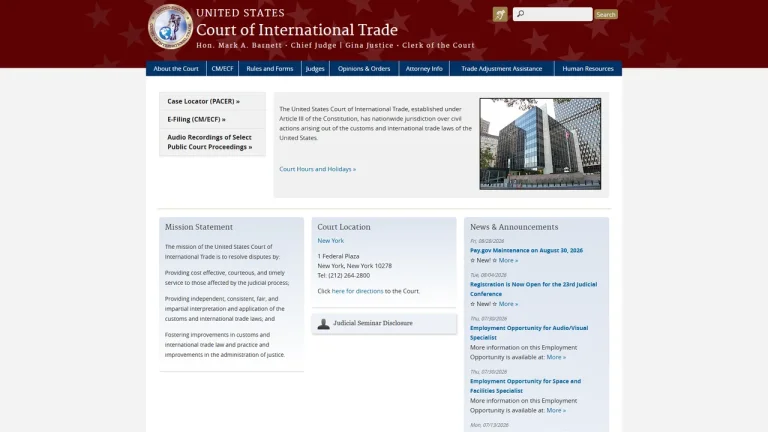
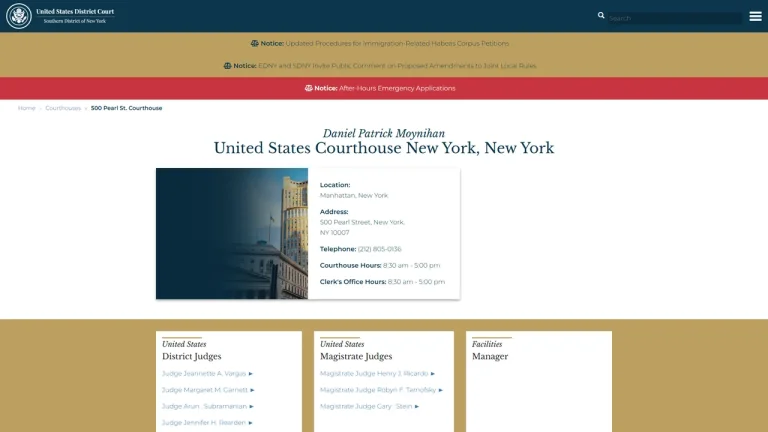
U.S. District Court - Southern District of New York - New York, NY

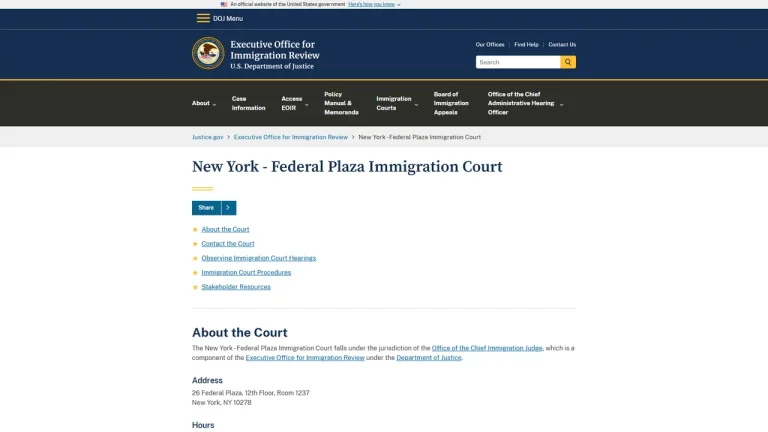
Executive Office of Immigration Review New York City Court - New York, NY



Manhattan Criminal Courthouse (Supreme Court, Criminal Term & NYC Criminal Court)
Environmental Control Board (OATH Hearings Division) - New York, NY

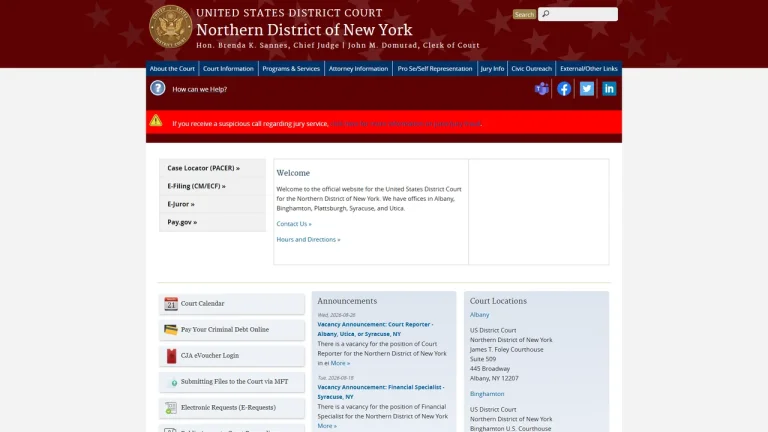


Bronx County Courthouse (Supreme Court, Civil & Surrogate's Court)

NY Appellate Division Third Dept Office of Attorney Admissions - Albany, NY
Southern District of New York Bankruptcy Court serving Bronx and New York Counties - New York, NY

Structure and Jurisdiction of the New York Court System
The New York State Unified Court System represents one of the most comprehensive judicial structures in the nation, administering justice across 62 counties organized into 13 Judicial Districts. Headquartered in Albany, the New York Court of Appeals serves as the state's highest constitutional tribunal, providing definitive statewide legal interpretations on civil and criminal appeals.
Below the Court of Appeals, intermediate appellate review is divided into four Appellate Divisions of the Supreme Court: the First Department in Manhattan, the Second Department in Brooklyn, the Third Department in Albany, and the Fourth Department in Rochester. The primary statewide trial court of unlimited general original jurisdiction is the New York State Supreme Court, which operates branches in every county alongside dedicated Commercial Divisions in major metropolitan commercial centers.
Specialized trial courts manage distinct subject matters: Surrogate's Courts oversee probate and estates, Family Courts adjudicate domestic relations and child welfare proceedings, County Courts handle felony criminal trials outside New York City, and the Court of Claims exercises exclusive jurisdiction over tort and contract claims against New York State.
New York Court Filing Fees & Procedural Timelines
| Service / Matter | Required Documents / Prerequisites | Statutory Fee (USD) | Processing Timeline |
|---|---|---|---|
| Index Number Purchase (Supreme Court Civil Action) | Summons with notice or summons and verified complaint, RJI | $210.00 statutory index number fee | Immediate digital issuance via NYSCEF; same-day in person. |
| Request for Judicial Intervention Filing (RJI) | Completed RJI form (UCS-840), proof of index number purchase | $95.00 statutory fee | Case assigned to presiding judge within 5 to 15 business days. |
| Notice of Appeal to Appellate Division (Civil Action) | Timely filed Notice of Appeal, CPLR 5531 statement, informational form | $65.00 ($315.00 to docket record on appeal) | Notice must be served within 30 days; record perfected within 6 months. |
| Small Claims Filing (City, Town, or Village Court) | Statement of claim, valid defendant mailing address in jurisdiction | $15.00 to $20.00 (Based on claim amount up to statutory limit) | Hearing scheduled within 3 to 6 weeks of filing date. |
Critical Legal Deadlines & Statutes in New York
Civil litigation timelines in New York are strictly codified in the Civil Practice Law and Rules. After being served with a summons and complaint, a defendant must serve an answer or pre-answer motion to dismiss under N.Y. C.P.L.R. § 3211 within 20 days if served personally within New York, or within 30 days if served by other statutory methods pursuant to N.Y. C.P.L.R. § 3012(c).
Appellate deadlines are strictly jurisdictional and cannot be extended by judicial discretion: under N.Y. C.P.L.R. § 5513(a), a Notice of Appeal must be served and filed within exactly 30 days after service of a copy of the order or judgment with written notice of its entry.
For summary judgment motions, parties must comply with N.Y. C.P.L.R. § 3212(a), which requires filing no later than 120 days after the note of issue is filed, unless the local court sets a shorter deadline. In criminal matters, statutory speedy trial parameters are enforced under N.Y. C.P.L. § 30.30, setting strict prosecutorial readiness deadlines based on the classification of the charged offense.
Small Claims Court vs. Retaining Professional Counsel
New York provides accessible forums for self-represented litigants in Small Claims courts. The monetary jurisdictional ceiling is $10,000 in the New York City Civil Court and City Courts across the state, and $3,000 in Town and Village Justice Courts. In these divisions, formal rules of evidence are simplified, and individuals can resolve straightforward contract or property disputes pro se without an attorney.
However, litigating in the New York State Supreme Court Civil Division, Commercial Division, or Court of Claims involves rigid adherence to the CPLR, formal disclosure mandates, expert exchanges, and strict motion practice. Furthermore, under N.Y. C.P.L.R. § 321(a), corporations and voluntary associations are legally prohibited from appearing pro se and must be represented by a licensed attorney. Retaining counsel ensures proper preservation of appellate records and aggressive protection of legal rights.
Red Flags & Court System Scams
- Fraudulent Jury Duty and Arrest Threat Scams: Beware of phone calls from scammers impersonating New York court officers or sheriff deputies claiming an active warrant exists for missed jury duty; New York courts never demand electronic payments or credit card numbers by telephone.
- Unauthorized NYSCEF Account Access: Protect court electronic filing credentials; only authorized attorneys and registered pro se litigants should file documents via NYSCEF, as unauthorized filings can result in court sanctions.
- Predatory Online Small Claims Advisors: Avoid unregulated third-party websites promising to guarantee a small claims victory or charging exorbitant preparation fees for simple statutory forms provided freely by court clerk offices.
- Bogus Subpoena Notifications via Unsolicited Emails: Exercise extreme caution with emails containing hyperlinks to purported court subpoenas or appearance notices; verify active dockets directly through the official WebCivil Supreme or WebCivil Local systems.
Frequently Asked Questions
What is the highest court in New York State?
The New York Court of Appeals, located in Albany, is the state's highest court, while the Supreme Court is the statewide trial court of general jurisdiction.
How do I look up an active court case in New York?
Active cases can be tracked online through the New York State Unified Court System WebCivil Supreme and WebCivil Local services, or via the NYSCEF electronic filing portal for e-filed cases.
Can a corporation represent itself in New York State Supreme Court?
No, under New York civil practice rules, corporations and voluntary associations must appear by an attorney admitted to practice in the state.
What is the monetary limit for Small Claims Court in New York?
The jurisdictional limit is $10,000 in New York City Civil Court and statewide City Courts, and $3,000 in Town and Village Justice Courts.
What is the deadline to appeal a New York State court order?
A party must serve and file a Notice of Appeal within 30 days after being served with a copy of the order or judgment with written notice of entry.