
Government Agencies in Rhode Island
Navigating Rhode Island state government agencies requires understanding administrative procedures, licensing requirements, and official petition pathways. Identifying the correct state department ensures that public filings, regulatory compliance, and administrative appeals proceed without unexpected delays. Explore our verified directory below to connect with Rhode Island executive departments, regulatory commissions, and administrative agencies statewide.

Federal Aviation Administration - Providence Tower - Warwick, RI



Warwick Public Schools - Gorton Administrative Building - Warwick, RI
U.S. Customs and Border Protection - Providence Service Port - Warwick, RI




State of Rhode Island Building Code Commission - Warwick, RI


State of Rhode Island DOT Division of Highway & Bridge Maintenance Headquarters - Warwick, RI
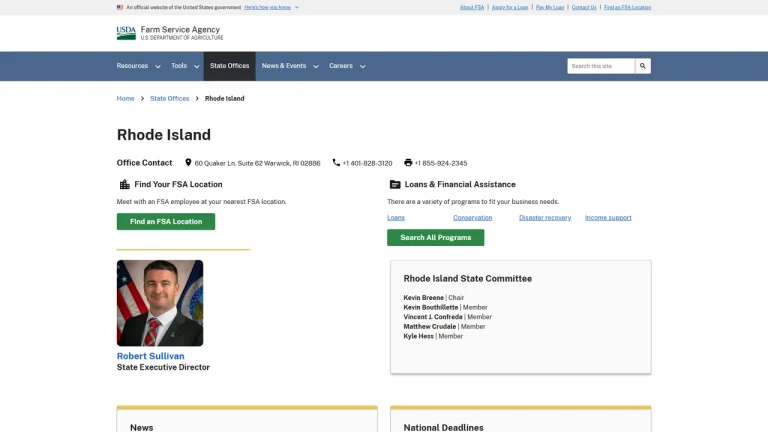
USDA Farm Service Agency - Rhode Island State Office - Warwick, RI

US Drug Enforcement Administration - Warwick Resident Office - Warwick, RI

Rhode Island State Administrative and Regulatory Architecture
Rhode Island state government operates primarily from the Capital Center and Smith Hill complex in Providence. Executive departments exercise statewide regulatory, licensing, and enforcement authority across all thirty-nine municipal cities and towns, overseeing commerce, public health, environmental standards, and administrative adjudication.
Key executive entities include the Department of Business Regulation (DBR), which oversees banking, securities, commercial licensing, and gaming; the Department of Labor and Training (DLT); the Department of Environmental Management (DEM); the Rhode Island Division of Taxation; and the Rhode Island Department of Health (RIDOH). The Office of the Attorney General, situated along South Main Street in Providence, enforces consumer protection mandates and represents the public interest in regulatory reviews.
Administrative governance in Rhode Island centralizes state regulatory oversight at the state level rather than through county administrations. Contested decisions, license denials, and regulatory violations are adjudicated by agency hearing officers in formal administrative proceedings governed by the Rhode Island Administrative Procedures Act before reaching the judicial court system.
Common Rhode Island State Agency Filings, Document Fees, and Timelines
| Service / Matter | Required Documents / Prerequisites | Statutory Fee (USD) | Processing Timeline |
|---|---|---|---|
| APRA Public Records Request | Written request identifying specific agency records, requester contact details | Free inspection; $0.15 per page copy fee under R.I. Gen. Laws § 38-2-4 | Up to 10 business days (extendable by 20 days for good cause) |
| Administrative Order Appeal | Complaint for judicial review, certified agency hearing record, service of summons | $160 Superior Court filing fee | Must be filed within 30 days of final administrative decision |
| Professional / Occupational Licensure | Completed board application, proof of credentials, state background examination | $60 to $300 depending on regulatory licensing board | 3 to 8 weeks depending on board review schedules |
| State Tort Claim Notice | Written statement of claim, itemized financial damages, proof of incident date | $0 (No statutory submission fee) | 3-year statutory limitations window under R.I. Gen. Laws § 9-1-25 |
Critical Legal Deadlines & Statutes in Rhode Island
Administrative actions in Rhode Island are bound by uncompromising statutory windows. Under the Rhode Island Administrative Procedures Act, specifically R.I. Gen. Laws § 42-35-15, any aggrieved party seeking judicial review of a final administrative agency ruling must file a complaint in the Rhode Island Superior Court within 30 days after the mailing of the final decision. Missing this 30-day deadline deprives the court of subject-matter jurisdiction and makes the agency ruling unappealable.
For monetary tort claims against the state resulting from personal injury or property damage, actions are governed by the Rhode Island Tort Claims Act under R.I. Gen. Laws § 9-1-25, which establishes a 3-year statute of limitations to commence legal action against the State of Rhode Island. Monetary recovery in tort actions against the state is subject to a statutory liability limitation under R.I. Gen. Laws § 9-31-2. Furthermore, under the Rhode Island Access to Public Records Act, codified at R.I. Gen. Laws § 38-2-3, public agencies must respond to records requests within 10 business days, with administrative appeals of denials required within 10 business days to the chief administrative officer under R.I. Gen. Laws § 38-2-8.
Direct Agency Access vs. Legal Counsel
Citizens and business operators can navigate routine administrative procedures directly through official state web services and department service desks. Submitting standard business tax returns with the Division of Taxation, registering corporate entity filings with the Department of State, or requesting public records under the Access to Public Records Act can be accomplished independently using standardized state forms.
However, when administrative disputes escalate to formal evidentiary hearings, retaining experienced legal counsel becomes crucial. Professional license disciplinary hearings before RIDOH licensing boards, commercial enforcement actions initiated by the Department of Business Regulation, and environmental disputes before the Department of Environmental Management involve formal administrative rules of evidence. While the Rhode Island District Court maintains a Small Claims division with a statutory limit of $2,500 under R.I. Gen. Laws § 10-16-1, administrative agency appeals cannot be adjudicated in small claims and require formal complaints filed in the Superior Court by legal counsel.
Common Red Flags & Regulatory Filing Scams
- Lookalike commercial websites charging $50 to $100 to prepare or submit standard Rhode Island administrative forms that are provided free of charge on official ri.gov agency domains.
- Unsolicited correspondence or text messages purporting to represent the Rhode Island Division of Taxation demanding immediate payment via non-standard financial methods like wire transfers or prepaid gift cards.
- Unlicensed expediter services claiming proprietary access or guaranteed results before state licensing boards, environmental permitting agencies, or alcoholic beverage regulators.
- Deceptive corporate filings solicitations that demand recurring annual service fees for statutory compliance documents that are not legally required by the Rhode Island Department of State.
Frequently Asked Questions
Where are the central offices for Rhode Island state agencies located?
Most Rhode Island state executive agencies, departments, and regulatory commissions are headquartered in Providence within the State Capitol Complex on Smith Hill and surrounding commercial office complexes in the downtown Capital Center district.
How do I appeal an adverse decision made by a Rhode Island state agency?
Under R.I. Gen. Laws § 42-35-15, you must file a complaint for judicial review in the Rhode Island Superior Court within 30 days of receiving the final administrative order after exhausting all available administrative remedies within the agency.
What is the statutory deadline for public records requests under the Rhode Island APRA?
Under R.I. Gen. Laws § 38-2-3, an agency must grant or deny access to requested records within 10 business days. The agency may extend this period by up to 20 additional business days if the request is voluminous or requires extensive retrieval efforts.
What is the monetary damage limit for claims against the State of Rhode Island?
Under R.I. Gen. Laws § 9-31-2, damages against the state in tort claims are generally subject to a statutory cap of $100,000, except in instances where the state was engaged in a proprietary or non-governmental enterprise.
Can a corporate entity appear without legal counsel in Rhode Island administrative proceedings?
While individuals may represent themselves pro se, corporations and limited liability companies appearing in formal contested administrative hearings or appealing to the Superior Court must be represented by an attorney licensed by the Rhode Island Bar.