
County & City Agencies in Boston
Access municipal departments, regulatory boards, and county-level administrative offices in Boston, Massachusetts. From Boston City Hall to specialized municipal commissions, public agencies manage local permitting, public health enforcement, and property assessments across Suffolk County. Explore our verified public directory below to identify agency service counters, administrative procedures, and legal compliance resources.


Administrative Governance & Municipal Jurisdiction in Boston
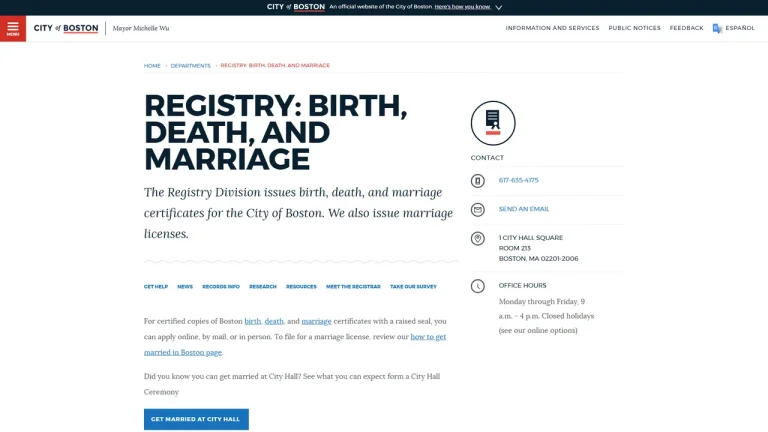
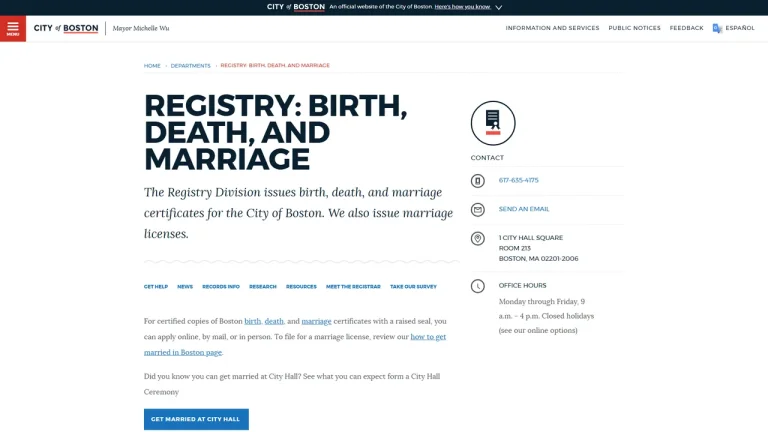
Municipal administration in Boston operates through a centralized executive and legislative structure based at Boston City Hall on One City Hall Square. City Hall accommodates the Office of the Mayor, the Boston City Council, and primary regulatory departments responsible for local governance across Suffolk County.
Following the statutory reorganization of county government in Massachusetts, traditional Suffolk County administrative functions were largely absorbed by the municipal government of Boston, while judicial registries and county correctional operations transitioned to state oversight. This framework creates a unified municipal administrative structure serving Boston and coordinating regional matters with neighboring municipalities including Chelsea, Revere, and Winthrop.
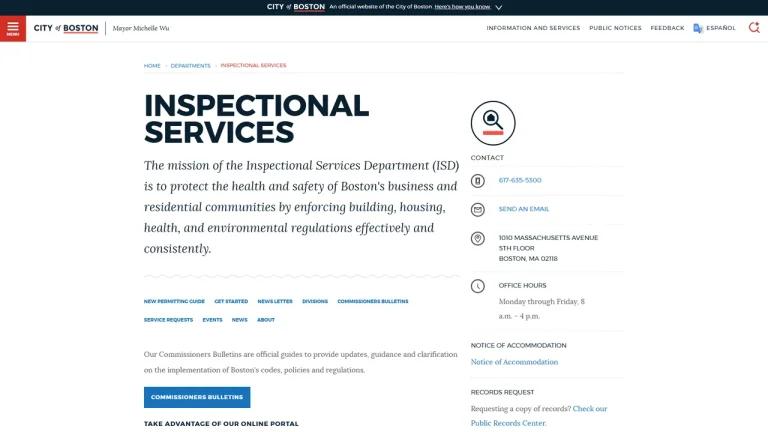
Key municipal regulatory bodies include the Boston Inspectional Services Department, located at 1010 Massachusetts Avenue in Roxbury, which oversees building code enforcement, housing standards, and environmental sanitation. The Boston Public Health Commission and the Boston Assessing Department oversee regulatory compliance across neighborhoods such as Downtown, Back Bay, South End, Charlestown, East Boston, South Boston, Roxbury, Dorchester, Jamaica Plain, and Brighton.
Boston Municipal Agency Services & Fee Schedule
| Service / Matter | Required Documents / Prerequisites | Statutory Fee (USD) | Processing Timeline |
|---|---|---|---|
| Building & Alteration Permit (Inspectional Services) | Architectural blueprints, licensed contractor credentials, zoning verification, scope narrative | Tiered fee scale based on construction valuation ($20 to $1,000+) | 15 to 30 business days departmental review |
| Property Tax Abatement Application (Assessing Dept) | State Tax Form 128, documentation of assessment error, property inspection records | No municipal filing fee | Due February 1 annually; determination within 3 months |
| Food Establishment Operating Permit (BPHC) | Floor plan schematics, certified food protection manager certificate, pest management contract | $100 to $300 tiered statutory fee | 14 to 21 business days including site inspection |
| Municipal Public Records Request (City Clerk) | Written request, specific document parameters, applicant contact information | Statutory duplication fees ($0.05 per standard page) | 10 business days statutory determination |
Critical Legal Deadlines & Statutes in Massachusetts
Administrative governance, municipal authority, and public disclosure requirements in Boston are governed by the Massachusetts General Laws. The structural transition and municipal absorption of county functions are codified under Mass. Gen. Laws ch. 34B, § 1, which dissolved traditional county administrative commissions and transferred municipal governance responsibilities directly to the City of Boston.
Public access to municipal government files is guaranteed by the Massachusetts Public Records Law pursuant to Mass. Gen. Laws ch. 66, § 10, requiring municipal records access officers to provide formal determinations within 10 business days of receiving a written request. Contesting real estate valuations requires strict adherence to Mass. Gen. Laws ch. 59, § 59, which mandates that property tax abatement applications be filed with the Boston Assessing Department on or before February 1 of the tax year; missing this deadline establishes an absolute statutory bar to relief.
Appealing local land use and zoning decisions made by the Boston Zoning Board of Appeal requires filing an appeal within 20 calendar days under the Boston Zoning Enabling Act and Mass. Gen. Laws ch. 40A, § 17. Parties pursuing tort claims or allegations of municipal negligence against the City of Boston must comply with the Massachusetts Tort Claims Act under Mass. Gen. Laws ch. 258, § 4, which mandates formal written presentment to the executive officer within two years of injury before any court action may be commenced.
Direct Agency Access vs. Legal Counsel
Citizens and local commercial operators can manage standard municipal administrative interactions directly. Submitting basic public records inquiries under Chapter 66, paying residential property taxes, applying for minor home renovation permits at the Inspectional Services Department, and renewing food service permits are standard administrative tasks handled directly at city counters or online.
Conversely, retaining an experienced administrative law or land use attorney is vital when facing formal municipal enforcement actions, navigating complex zoning variance applications, or defending against code violation notices. Legal counsel is essential when preparing variance petitions before the Boston Zoning Board of Appeal, appealing tax assessment denials to the Massachusetts Appellate Tax Board, litigating municipal property takings, or drafting statutory presentment notices under the Massachusetts Tort Claims Act.
Red Flags & Warnings in Municipal Proceedings
- Missing the strict February 1 deadline under Massachusetts General Laws Chapter 59 to file a property tax abatement application, which permanently forfeits assessment appeal rights.
- Commencing commercial construction or changing property occupancy without required permits from Inspectional Services, resulting in stop-work orders and daily fines.
- Relying on unauthorized third-party online portals that charge convenience fees to file free municipal service requests or public records applications.
- Failing to serve a formal written presentment letter within two years under Chapter 258 when asserting damages against municipal authorities, barring judicial recovery.
Frequently Asked Questions
Where is Boston City Hall located?
Boston City Hall is located at One City Hall Square in Downtown Boston, serving as the executive headquarters for the Mayor's Office, the Boston City Council, and the City Clerk.
How does county government work in Suffolk County?
Under Massachusetts General Laws Chapter 34B, traditional county governance was abolished in Suffolk County, and municipal administrative operations were absorbed directly by the City of Boston, while judicial agencies operate under state authority.
What department handles building permits and code enforcement in Boston?
The Boston Inspectional Services Department, located at 1010 Massachusetts Avenue in Roxbury, manages building permits, zoning examinations, code inspections, and housing safety standards.
How do I appeal a property assessment with the Boston Assessing Department?
Property owners must file an official abatement application (State Tax Form 128) with the Boston Assessing Department on or before February 1 of the tax year following the issuance of the third-quarter actual tax bill.
What is the statutory deadline to appeal a Boston Zoning Board decision?
Decisions of the Boston Zoning Board of Appeal must be appealed by filing a complaint in the Suffolk County Superior Court or Massachusetts Land Court within 20 calendar days after the decision is filed with the City Clerk.