
Law Enforcement & Corrections in New York
Law enforcement and correctional systems in New York encompass state police barracks, county sheriffs, municipal departments, and state correctional facilities. Citizens and families interact with these departments for arrest records, inmate locator inquiries, bail postings, and correctional visitation protocols. Explore our verified public directory below to identify facility locations, visiting guidelines, and official agency contacts.

New York City Police Department - 30th Precinct - New York, NY



New York City Police Department - 73rd Precinct - Brooklyn, NY
New York State Police Forensic Investigation Center - Albany, NY



New York City Special Commissioner of Investigation - New York, NY
NYS Department of Corrections and Community Supervision - Albany, NY

New York State Division of Human Rights - Albany, NY

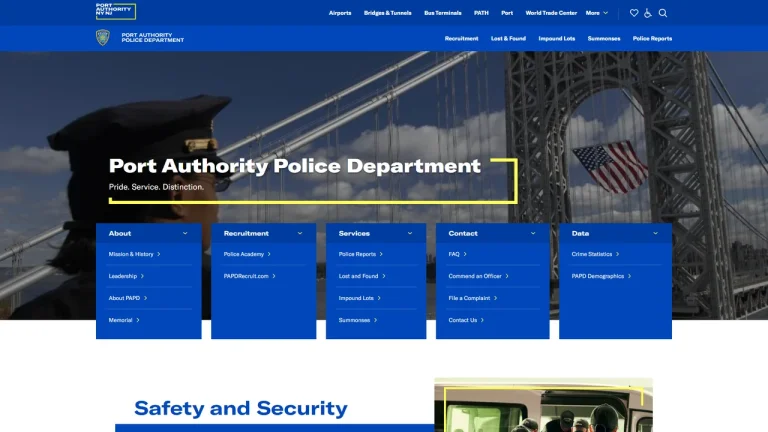
Port Authority Police Command - Port Authority Bus Terminal - New York, NY
New York City Police Department - Headquarters - New York, NY
Law Enforcement Jurisdiction and Correctional Systems Across New York
Law enforcement and correctional administration in the State of New York is structured across distinct state, county, and municipal authorities. State-level incarceration, post-release supervision, and parole coordination are governed by the New York State Department of Corrections and Community Supervision (NYSDOCCS), headquartered in Albany. NYSDOCCS manages dozens of state correctional facilities ranging from maximum-security institutions such as Sing Sing, Attica, and Green Haven to medium and minimum-security facilities across the state.
Local detention and pre-trial holding are organized at the county and municipal levels. Across upstate New York and Long Island, local jails are operated under the constitutional authority of the elected County Sheriff in each county, such as the Erie County Holding Center in Buffalo, the Monroe County Jail in Rochester, and the Albany County Correctional Facility. Within the five boroughs of New York City, pre-trial detention is administered by the New York City Department of Correction (NYCDOC), operating the Rikers Island jail complex and borough holding centers under the independent regulatory oversight of the New York State Commission of Correction.
Primary law enforcement agencies include the New York State Police (NYSP), organized into regional Troops spanning the state's highways and rural municipalities, municipal police forces such as the New York City Police Department (NYPD) and Buffalo Police Department, and county sheriff road patrols. Each agency enforces the New York Penal Law and coordinates with local District Attorneys to conduct criminal prosecutions.
Common Law Enforcement Services, Prerequisites, and Timelines in New York
| Service / Matter | Required Documents / Prerequisites | Statutory Fee (USD) | Processing Timeline |
|---|---|---|---|
| NYSDOCCS Inmate Lookup & Visitation Booking | Registered visitor status, valid government photo ID | $0 (No fee) | 1 to 3 days advance scheduling |
| New York State Police Collision Report Request | Form DP-1 or online request, accident date, troop code | $15 | 5 to 10 business days |
| Criminal Record Sealing Petition (CPL 160.59) | Certificate of disposition, sworn petition, 10-year period proof | $0 (No filing fee) | 3 to 6 months for court decision |
| County Jail Cash Bail Posting | Valid government photo ID, exact cash or certified bank draft | Bail amount + statutory surcharge | 2 to 8 hours for release processing |
Critical Legal Deadlines & Statutes in New York
Interacting with law enforcement and detention systems in New York involves strict adherence to the New York Criminal Procedure Law. Following an arrest, an individual must be brought before a local criminal court judge for formal arraignment without unnecessary delay, typically required within 24 hours under N.Y. C.P.L. § 140.20.
Pre-trial release determinations are strictly governed by New York's bail statutes codified at N.Y. C.P.L. § 510.10. For most misdemeanors and non-violent felonies, judges must release defendants on their own recognizance or under non-monetary conditions, with monetary bail and pre-trial detention restricted to specifically designated qualifying offenses.
Criminal matters must satisfy speedy trial mandates under N.Y. C.P.L. § 30.30. The prosecution must declare readiness for trial within statutory limits: six months for felony charges, ninety days for Class A misdemeanors, sixty days for Class B misdemeanors, and thirty days for non-criminal violations.
Individuals seeking to seal eligible prior convictions can petition under N.Y. C.P.L. § 160.59. Petitioners may request the sealing of up to two convictions (only one of which may be a felony) once ten years have elapsed since sentencing or release from prison. When pursuing civil damages against a municipal police department for false arrest or excessive force, a formal Notice of Claim must be served within ninety days pursuant to N.Y. Gen. Mun. Law § 50-e.
Direct Agency Access vs. Legal Representation
Citizens have direct access to administrative correctional tools across New York. Family members can utilize the free public NYSDOCCS Inmate Lookup portal to verify an incarcerated individual's DIN number, check security classifications, deposit approved commissary funds, and schedule facility visits. Similarly, crime victims can access automated custody updates through the state VINELink system without legal representation.
However, when interactions involve custodial interrogations, arraignments, pre-trial bail arguments, parole revocation hearings before the Board of Parole, or post-conviction record sealing motions in County Court, retaining defense counsel is essential. Under New York law, indigent defendants facing criminal charges are entitled to assigned counsel under County Law Article 18-B. Experienced legal counsel protects constitutional rights during police questioning, challenges statutory speedy trial violations, and advocates for release under CPL 510.10.
Red Flags & Public Access Warnings
- Commercial online search services charging subscription fees for inmate tracking or release information that is publicly accessible for free on the official NYSDOCCS lookup database.
- Unlicensed bail agents demanding non-refundable fees exceeding statutory premium caps established by the New York State Department of Financial Services under Insurance Law Section 6804.
- Impostor telephone scams where callers claim to represent the State Police or a County Sheriff demanding bail payments or fine clearances via wire transfers, prepaid debit cards, or cryptocurrency.
- Private prison consulting firms guaranteeing early release, medical clemency, or transfer to specific minimum-security camps, which are governed entirely by NYSDOCCS internal classifications.
Frequently Asked Questions
How do I find someone incarcerated in a New York state prison?
You can use the official NYSDOCCS Inmate Lookup portal on the department's website. Searching by the individual's Department Identification Number (DIN) or legal name provides their current facility location and parole eligibility dates.
How does New York's bail law affect pre-trial detention?
Under New York Criminal Procedure Law Section 510.10, cash bail cannot be set for the majority of non-violent felony and misdemeanor charges. Judges must release individuals on recognizance or set non-monetary release conditions unless a legally defined qualifying offense is charged.
What identification is required to visit an inmate in a NYSDOCCS facility?
Adult visitors must present a valid, government-issued photo ID (such as a driver's license or passport). Visitors must be on the inmate's approved visitor list and comply with the facility dress code and scheduling rules.
Can a criminal record be expunged in New York State?
New York does not have a general expungement statute, but eligible individuals can apply to have their records sealed under Criminal Procedure Law Section 160.59 after ten crime-free years, removing the record from public view.
What should I do if a family member is arrested in New York?
Contact the local police precinct or Central Booking in that county to locate the individual. Ensure they invoke their right to remain silent and request an attorney immediately, as arraignment must occur within approximately 24 hours.